
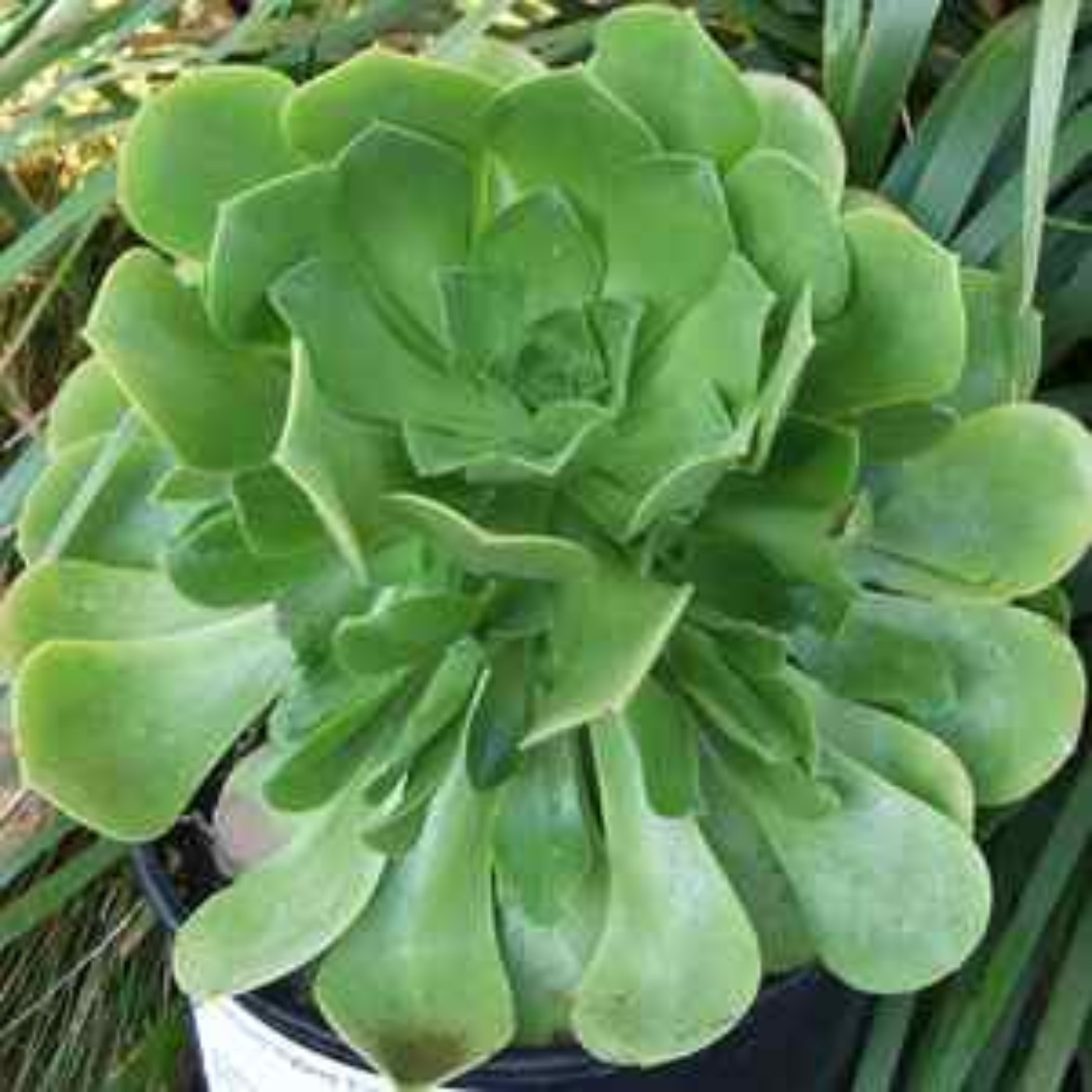
'Carol' produces broad, nearly horizontal green rosettes, sometimes touched with red, that gather into an expansive clump.
- Accepted name
- Aeonium ‘Carol’
- Type
- Horticultural cultivar
- Other names
- AKPMG # 2
- Horticultural provenance
- Alice Keck Park Memorial Garden, Santa Barbara (California)
- Named in honour of
- Carol Terry
- Date
- 2005 — Commercial introduction
- Possible parentage
- Aeonium canariense
- Habit
- Clump of rosettes
- Branching
- Branching
- Documented height
- 30–60 cm
- Rosette diameter
- 30–45 cm
- Spread
- 60–90 cm
- Genus
- Aeonium
- Country of origin
- United States
Family tree
Reserved for Premium members
Origin and history
The selection came from plants grown at Alice Keck Park Memorial Garden in California. It was introduced commercially in 2005 and named in honour of Carol Terry. Before receiving that name, the plant was also recorded as AKPMG #2. A possible link to Aeonium canariense has been proposed, but remains hypothetical.
Chronological milestones
2005 — San Marcos Growers introduces this cultivar from Alice Keck Park Memorial Garden and names it ‘Carol’ in honour of Carol Terry.
Botanical description
Aeonium ‘Carol’ is a large-growing succulent cultivar with a relatively low but widely spreading habit. Its branching stems terminate in broad, almost horizontal rosettes, which gradually increase in number to form a substantial clump. Horticultural descriptions generally give a height of 30–60 cm and a spread of 60–90 cm for well-established plants. These figures are observations from cultivation, not fixed dimensions.
The rosettes may reach approximately 30–45 cm across, and occasionally more on individual plants. Their long, fleshy leaves have been reported at about 15–25 cm in length. The leaves are thick, relatively broad and slightly wavy along their margins, lending the large rosettes a saucer-like appearance. The leaf blades are mainly light to bright green, sometimes with reddish tones, especially near the tips and edges. The intensity of these shades varies with exposure and growing conditions; this is not stable variegation.
The combination of exceptionally broad, almost flat rosettes, bright-green, gently undulating leaves and a clump-forming habit is the most recognisable aspect of ‘Carol’. A contribution from Aeonium canariense has been proposed to account for its appearance, but no precise parental cross has been demonstrated. These are approximate horticultural measurements rather than fixed botanical dimensions.
Flowering
Have you photographed this cultivar in bloom? Share flowering photographs on the Forum.
Flowering is reported to be relatively infrequent in cultivation. Some horticultural observations suggest that individual rosettes may not invariably die after flowering. This unusual behaviour remains to be confirmed and does not establish an exception to the usual monocarpic flowering of individual Aeonium rosettes. No sufficiently verified description of the flowers specific to ‘Carol’—their colour, dimensions or petal number—was found.
Photographs
Do you grow this cultivar? Help document its shapes and seasonal colours. Share your photographs on the Forum.
Growing conditions
☀️ Light
Keep in very bright conditions and acclimatise the broad rosettes before moving into stronger direct sun.
💧 Watering
Water while roots are active, then allow the mix to dry. Reduce water substantially if growth slows.
🪨 Potting mix
Choose a broad pot and very free-draining mix: this selection can form a sizeable clump with large rosettes.
🌡️ Temperatures
Shelter from frost and prolonged cold damp weather, especially when grown in a large container.
Help us enrich this profile
An observation, a correction or photographs? Share your knowledge with us.


