
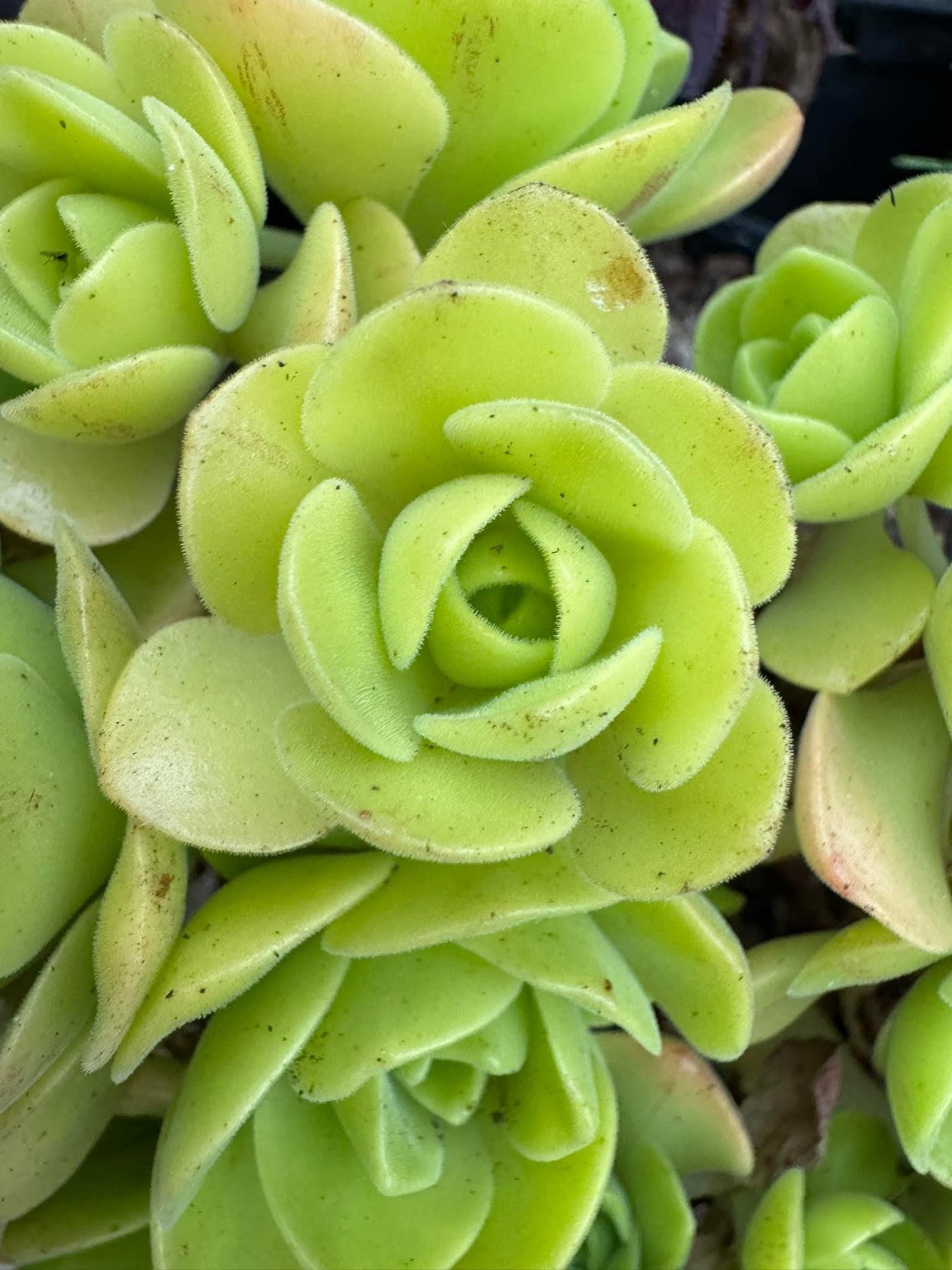
'Edinburgh' stays close to the ground, making a rounded clump of soft green rosettes whose tips can turn orange in summer.
- Accepted name
- Aeonium ‘Edinburgh’
- Type
- Horticultural cultivar
- Horticultural provenance
- Royal Botanic Garden Edinburgh, Scotland
- Circulation under this name
- Around 2015
- Possible parentage
- Aeonium sedifolium × Aeonium canariense subsp. virgineum
- Habit
- Low, nearly creeping shrub
- Branching
- Branching
- Documented height
- 10–20 cm
- Genus
- Aeonium
Family tree
Reserved for Premium members
Origin and history
The name ‘Edinburgh’ was given by the Ferme botanique de Kerveat to a plant obtained from the Royal Botanic Garden Edinburgh. In 2015, the garden’s collection manager supplied Kerveat with two rosettes taken from an Aeonium grown in its arid greenhouse under the probably incorrect label Aeonium goochiae. The plant’s exact origin remains unknown. Kerveat considers it close to Aeonium × nogalesii and suggests a possible cross between Aeonium sedifolium and Aeonium canariense subsp. virgineum. This parentage has not been confirmed by a controlled recreation of the cross. The year 2015 records the transfer of cuttings, not a demonstrated date of the hybrid’s creation.
Chronological milestones
Before 2015 — The plant is present at the Royal Botanic Garden Edinburgh before reaching cultivation under the name ‘Edinburgh’.
2015 — The plant begins circulating under the name ‘Edinburgh’.
Botanical description
Aeonium ‘Edinburgh’ is a small, low-growing, freely branching succulent subshrub. In cultivation, its height is generally reported to be around 10–20 cm. Short, spreading branches carry numerous terminal rosettes; together they give the plant a rounded, bushy, almost creeping outline. Despite its modest size, it produces additional rosettes generously and develops into a well-filled clump.
The fleshy leaves are relatively long in proportion to the plant’s small overall size, softly downy and slightly sticky to the touch. Their main colour is a luminous soft green. As light levels increase in summer, the leaf tips can acquire warm orange tones while most of each blade remains green. This colouring varies with the season and growing conditions; it is not a fixed variegation.
The combination of elongated, softly hairy, somewhat sticky leaves with an exceptionally low, strongly branched habit is especially characteristic. The cultivar can grow in both sun and partial shade. However, the sources consulted do not provide confirmed botanical measurements for the leaves or rosettes, nor a documented description of the flowers specific to ‘Edinburgh’. Floral characters should therefore not be inferred from its proposed parents.
Flowering
Have you photographed this cultivar in bloom? Share flowering photographs on the Forum.
Flowering has not yet been documented.
Photographs
Do you grow this cultivar? Help document its shapes and seasonal colours. Share your photographs on the Forum.
Summer photographs

Growing conditions
☀️ Light
Bright light helps maintain the low habit and summer leaf tones. Acclimatise gradually to direct sun.
💧 Watering
Water as growth resumes, then allow the soil to dry. Reduce watering during summer slowdown.
🪨 Potting mix
A relatively broad pot and free-draining mix suit its low branches, which grow close to the ground.
🌡️ Temperatures
Keep frost-free in winter and avoid leaving low branches resting on persistently cold, wet compost.


