
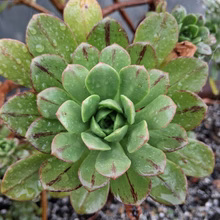
Aeonium × burchardii is a small upright, branching subshrub with fleshy, slightly sticky leaves, named for the collector Oscar Burchard.
- Accepted name
- Aeonium × burchardii (Praeger) Praeger
- Type
- Natural botanical hybrid
- Other names
- x buchardii
- Natural origin
- Tenerife, Canary Islands (Spain)
- Collector
- Oscar Burchard
- Reference collection
- 1923
- Documented parentage
- Aeonium pseudourbicum × Aeonium sedifolium
- Habit
- Upright shrub
- Branching
- Branching
- Documented height
- at least 30 cm
- Botanical name
- Aeonium × burchardii
- Genus
- Aeonium
- Origin type
- Natural hybridization
- Country of origin
- Spain
- Native range
- Canary Islands
- Parents
- pseudourbicum × sedifolium
Family tree
Reserved for Premium members
Origin and history
Oscar Burchard gathered the reference material in January 1923 between Masca and Santiago on Tenerife. Praeger published the natural cross of Aeonium pseudourbicum and Aeonium sedifolium in 1925 as Sempervivum burchardii. The name was transferred to Aeonium in 1929. These dates mark collection and botanical description of a hybrid already growing in the wild.
Chronological milestones
January 1923 — In January, Oscar Burchard collects reference material between Masca and Santiago on Tenerife, at 800–900 m elevation.
1925 — Praeger publishes Sempervivum burchardii, the basis of the combination published in Aeonium in 1929.
1929 — Praeger places the plant in Aeonium as Aeonium × burchardii, six years after the material was collected.
2025 — This hybrid of Aeonium pseudourbicum and Aeonium sedifolium is introduced in the United Kingdom.
Botanical description
Aeonium × burchardii is a natural hybrid from Tenerife arising from Aeonium pseudourbicum and Aeonium sedifolium. It forms an upright, branching succulent subshrub, reaching around 30 cm in height and sometimes more according to historical descriptions. Its relatively slender stems become woody with age and are smooth and rich brown. The branch tips bear rather open, loosely arranged rosettes whose size and arrangement can vary with growing conditions.
The fleshy, thick leaves are generally 6–10 cm long in botanical accounts. Their dark green, glossy blades have a distinctly keeled underside, with a pronounced longitudinal ridge. The leaf margins carry scattered short cilia. The surface may feel slightly sticky, recalling Aeonium sedifolium. Crimson-red streaks or markings sometimes appear near the leaf tips, while rosette colours may shift with light exposure and season.
The hybrid thus combines the relatively large leaves associated with A. pseudourbicum with some of the texture and pigmentation of A. sedifolium. Field studies have recorded more than one morphological form. Older publications sometimes interpreted it as a cross involving A. urbicum; Ángel Bañares’ field research led to the recognition of A. pseudourbicum as the parent in the Masca area. This natural variation should not, on its own, be treated as evidence of separate cultivars.
Flowering
Have you photographed this cultivar in bloom? Share flowering photographs on the Forum.
The inflorescence is described as relatively small, low and spreading, with an almost flat-topped outline. The flowers are usually 8- or 9-merous and display ochre to buff-yellow tones, rather than the vivid yellow seen in many other Aeonium. In populations studied near Tamaimo, Ángel Bañares also observed clearly pubescent inflorescences and petals. The sources consulted do not establish a sufficiently reliable flowering season for all forms of this hybrid.
Photographs
Do you grow this cultivar? Help document its shapes and seasonal colours. Share your photographs on the Forum.
Growing conditions
☀️ Light
Provide ample light without moving abruptly from shade into intense sun.
💧 Watering
Water during active growth and wait for the potting mix to dry between waterings.
🪨 Potting mix
A mineral-rich free-draining mix and a stable pot suit its upright habit.
🌡️ Temperatures
Protect from frost and avoid persistently cold, wet conditions under cover.
Help us enrich this profile
An observation, a correction or photographs? Share your knowledge with us.


