
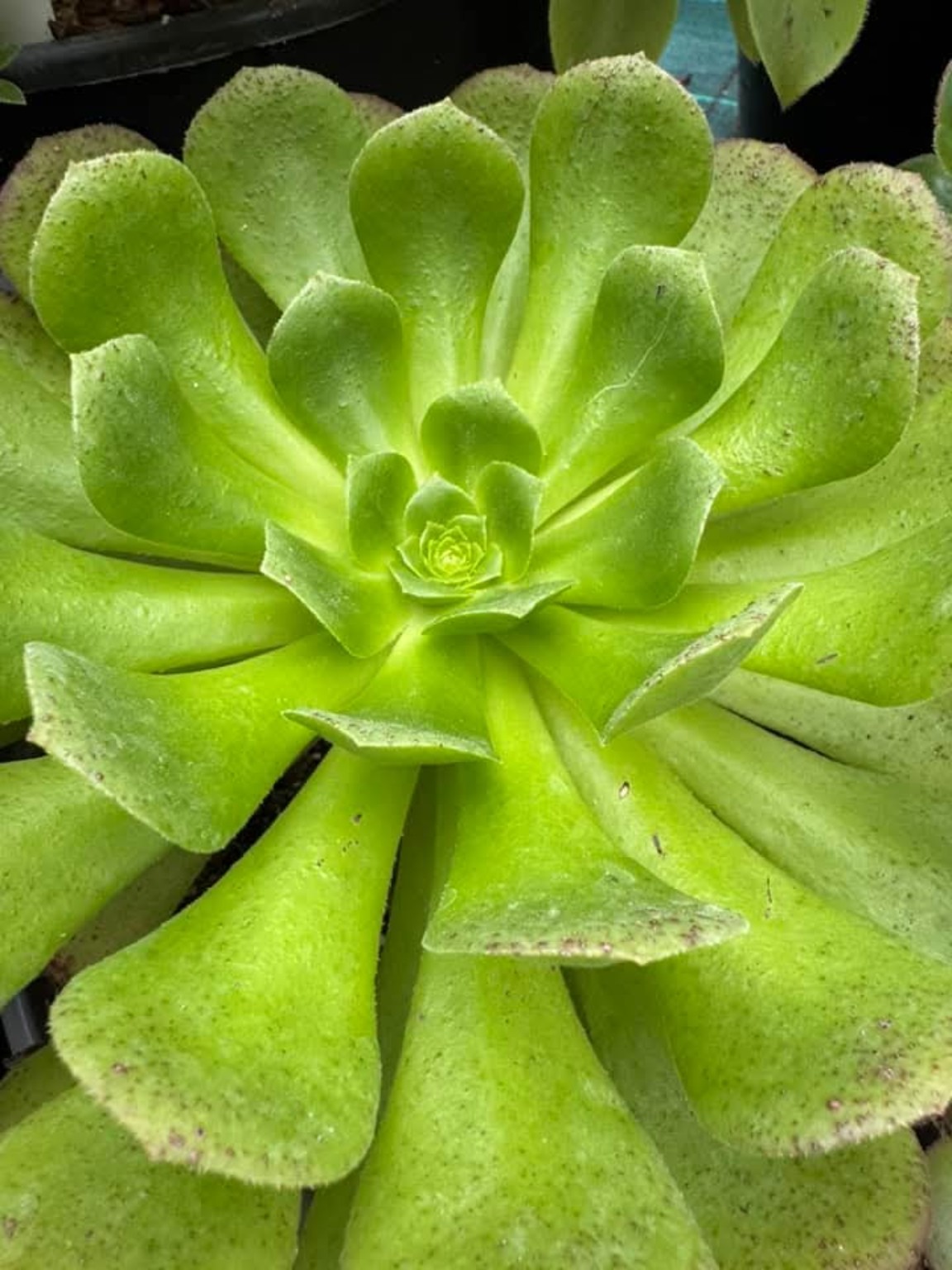
Aeonium × tabulicum is a rare natural hybrid from Tenerife, arising from Aeonium tabuliforme and Aeonium urbicum subsp. urbicum. It combines a relatively slender, elongated stem with flattened rosettes of densely overlapping leaves.
- Accepted name
- Aeonium × tabulicum Bramwell & G.D.Rowley ex Bañares
- Type
- Natural botanical hybrid
- Natural origin
- Tenerife, Canary Islands (Spain)
- Date
- 1929 — First documented mention
- Documented parentage
- Aeonium tabuliforme × Aeonium urbicum
- Habit
- Upright
- Botanical name
- Aeonium × tabulicum Bramwell & G.D.Rowley ex Bañares
- Other names
- Tabulicum · tabuliforme × urbicum
- Genus
- Aeonium
- Origin type
- Hybridization
- Country of origin
- Spain
- Native range
- Tenerife
- Parents
- tabuliforme × urbicum
Family tree
Reserved for Premium members
Origin and history
Aeonium × tabulicum is a natural hybrid from Tenerife, formed between Aeonium tabuliforme and Aeonium urbicum subsp. urbicum. Robert Lloyd Praeger documented the parental combination as early as 1929, based on plants seen in western Tenerife, above Los Silos. His account included a leaf drawing that remains an important historical reference for the nothotaxon.
David Bramwell and Gordon D. Rowley proposed the name Aeonium × tabulicum in 1973. Its nomenclatural validity was subsequently debated, and Ángel Bañares treated the name in Vieraea in 2015, using the authorship Bramwell & G.D.Rowley ex Bañares cited in his later study. These dates concern scientific documentation and naming, not the original emergence of the wild hybrid.
The plant has also been recorded above El Palmar and near Bajamar in northern Tenerife, at approximately 150 m above sea level. In his 2021 study, Bañares describes it as very rare among its parents and publishes a detailed illustration based on herbarium material TFC 48698, together with a previously unpublished account of its floral features.
Chronological milestones
1929 — Praeger is reported to have mentioned the cross between Aeonium tabuliforme and Aeonium urbicum before the name × tabulicum was published.
1973 — Bramwell and Rowley propose the name × tabulicum before its later nomenclatural validation.
2015 — Bañares validates Bramwell and Rowley's proposed name for Aeonium × tabulicum.
2021 — Bañares publishes further details of the hybrid's description and distribution in Vieraea.
Botanical description
Habit and rosette structure
This nothotaxon combines architectural features of its two parents. Its stem is distinctly elongated, unlike the almost stemless Aeonium tabuliforme, yet remains narrower than the stout stem of Aeonium urbicum. It bears a spreading terminal rosette, contrasting with the generally taller, upright habit of its second parent.
The rosette is strongly flattened, with numerous fleshy leaves densely packed and overlapping in regular layers to produce a broad, disc-like outline much like Aeonium tabuliforme. This combination of an obvious stem with an almost table-flat rosette is the hybrid’s most useful identifying feature. Available publications do not establish one standard mature height or rosette diameter applicable to all individuals.
Leaves and marginal hairs
Leaves are green and fleshy, closely arranged and broader towards their tips. Their tightly overlapping arrangement keeps the rosette remarkably flat, even when borne at the end of a visible stem. Leaf shape recalls Aeonium tabuliforme, but the margins combine traits associated with both parents.
One particularly useful diagnostic feature is the mixture of marginal hairs: relatively thick, usually blunt cilia alternate with longer, slender, needle-shaped glandular hairs. This combination was documented by Ángel Bañares in 2021 and helps distinguish the hybrid more precisely than rosette shape alone.
Flowering
Have you photographed this cultivar in bloom? Share flowering photographs on the Forum.
Flowering has been documented in June and July. The mature rosette produces a dome-shaped terminal inflorescence about 40 cm tall and 30 cm across, densely covered in glandular hairs. Flower-bearing branches measure 8–15 cm, divide dichotomously, and carry ovate bracts becoming lanceolate near the tips, together with clusters of numerous small flowers.
Flowers are generally eight- or nine-merous. Their lance-shaped, tapering petals measure approximately 8–9 mm long and 2–2.5 mm wide and are yellowish white with greenish tinges, with fine hairs on their outer surface. The calyx is glandular-hairy, the stamens are hairless and the nectaries are bilobed. These floral details were established in Bañares’s 2021 study from documented material; the hybrid should not simply be assigned the yellow flowers of its Aeonium tabuliforme parent. As with terminally flowering Aeoniums, the flowering rosette normally completes its life cycle after fruiting.
Photographs
Do you grow this cultivar? Help document its shapes and seasonal colours. Share your photographs on the Forum.
Winter photographs

Growing conditions
☀️ Light
Maintain good light for the flattened rosettes; introduce direct sun gradually.
💧 Watering
Water during growth and then allow the mix to dry. Restrict watering during rest.
🪨 Potting mix
Provide a stable pot and a very free-draining mix for its longer stem and flattened rosettes.
🌡️ Temperatures
Protect from frost and cold dampness, favouring light and ventilation under cover.


