
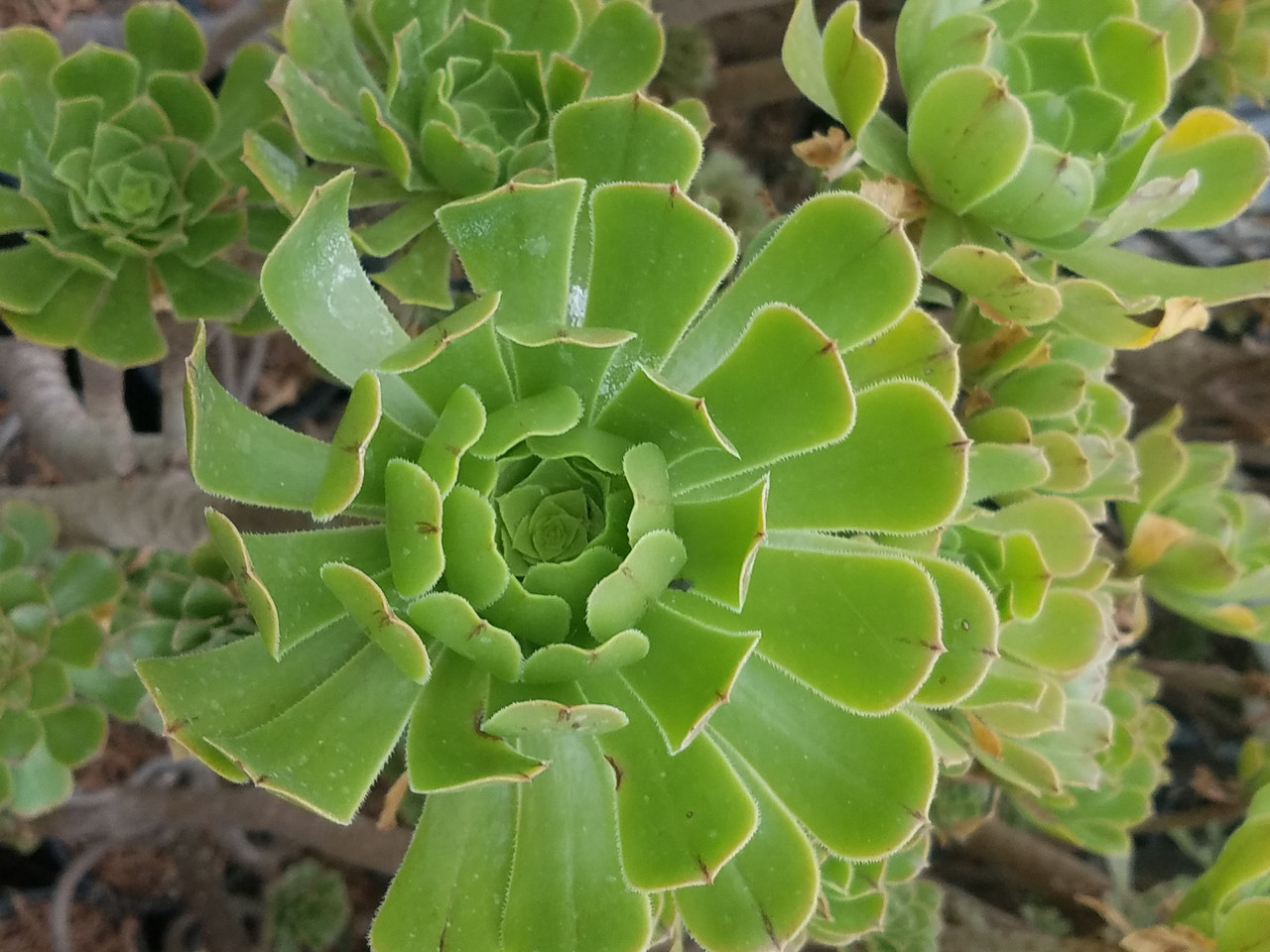
Upright stems, great crowns of green leaves and occasionally a bouquet of golden stars: Aeonium arboreum is one of those classics that can turn a succulent collection into a miniature garden.
- Reference name
- arboreum
- Botanical name
- Aeonium arboreum (L.) Webb & Berthel.
- Genus
- Aeonium
- Type
- Botanical taxon
- Country of origin
- Spain
- Growth habit
- Shrubby
- Plant height
- Up to 200 cm
- Rosette diameter
- 10–25 cm
- Branching
- Sparsely branching
- Date
- 1840 — Publication of the botanical name
Origin and history
Native to the Canary Islands and south-west Morocco in its broad sense, Aeonium arboreum holds an important place in the genus. The nominal subspecies is native to northern and central Gran Canaria. Plants of the World Online also recognises subspecies holochrysum and korneliuslemsii; the latter is native to south-west Morocco.
Linnaeus published Sempervivum arboreum in 1753 in Species Plantarum. Webb and Berthelot transferred it to Aeonium in 1840. This explains the full botanical name Aeonium arboreum (L.) Webb & Berthel., whose epithet recalls its tree-like habit.
The species and its selections have a long place in collections, particularly ‘Atropurpureum’ and variegated forms such as ‘Albovariegatum’. In 2024 the Royal Horticultural Society recognised cultivated plants for their sturdy structure and clean green foliage.
Chronological milestones
1753 — In Species Plantarum, Linnaeus describes the species as Sempervivum arboreum, nearly a century before its current name.
1840 — Webb and Berthelot retain Linnaeus's epithet arboreum and place the plant in Aeonium in their natural history of the Canary Islands.
2024 — The Royal Horticultural Society's 2022–2024 trial recognises Aeonium arboreum with the Award of Garden Merit.
Botanical description
Crowns of leaves on upright branches
The nominal form is a perennial subshrub with ascending or upright branches, often relatively sparsely branched in the wild. It can reach two metres, with rosettes 10–25 cm across according to Nyffeler’s botanical description. Cultivated specimens may branch more freely, depending on age and management.
The fleshy leaves broaden towards their tips and end in a little point. Their smooth, glossy surfaces are mainly green, sometimes flushed purple, with tiny curved cilia along the margins.
In the cooler growing months, the rosettes open into broad crowns, revealing their elegant spiral. When summer becomes hot and dry, young leaves press together in the centre and older ones dry. This natural adaptation is not necessarily a sign of disease.
Flowering
A mature rosette may send up an oval to conical inflorescence carrying numerous small yellow flowers. The nominal form usually has nine to eleven floral parts; the RHS trial recorded spring flowering, but timing varies with growing conditions. The flowering rosette dies afterwards, while the other heads continue growing.

Photographs
Do you grow this cultivar? Help document its shapes and seasonal colours. Share your photographs on the Forum.
General photographs

Mutations of ‘arboreum’
Direct mutations


Documented descendants of ‘arboreum’
Reserved for Premium members
Growing conditions
☀️ Light
A bright position suits this plant. Acclimatise it gradually to direct sun, particularly in spring.
💧 Watering
Water in active growth, allow the mix to dry, and reduce watering when crowns tighten in summer.
🪨 Substrate
Use an airy, free-draining mix and a stable container for mature tree-like plants.
🌡️ Temperatures
Protect from frost and prolonged cold rain. Large container plants benefit from a bright winter shelter.


