
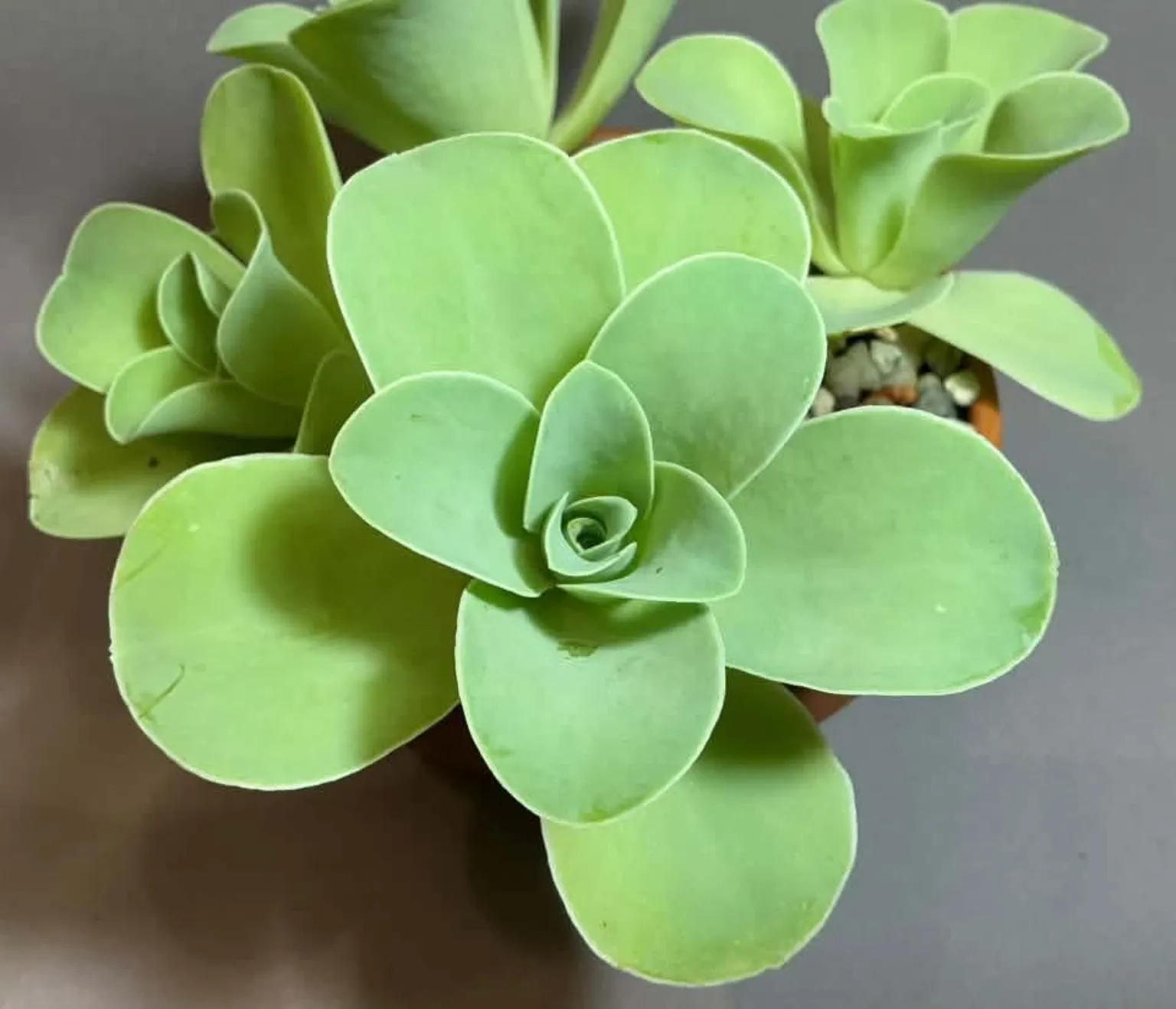
In the heat of summer, Aeonium aureum looks like a green rose folded carefully shut. This almost geometric plant comes from the mountains of the Canary Islands, and for much of its history it was known as a Greenovia.
- Reference name
- aureum
- Botanical section
- Greenovia
- Other names
- greenovia aurea · Aeonium diplocycla · Greenovia diplocycla · diplocycla
- Genus
- Aeonium
- Type
- Botanical taxon
- Growth habit
- Open rosette
- Rosette diameter
- 8–25 cm
- Date
- 1819 — Publication of the botanical name
Origin and history
For many years, this extraordinary succulent seemed to belong to a world of its own. Its first name, Sempervivum aureum, was published by Hornemann in 1819, using a name attributed to the botanist Christen Smith. Later, Webb and Berthelot placed it in the genus Greenovia; the name Greenovia aurea was published in 1841.
Its deep, cup-shaped rosettes and curious habit of folding shut in dry weather made the Greenovias especially memorable to growers. Botanical understanding continued to develop, however, and in 1995 the species received its current name, Aeonium aureum. The older name remains widely recognised in horticulture, a reminder of the group to which these distinctive plants once belonged.
The species grows naturally among volcanic rocks on Gran Canaria, Tenerife, La Gomera, La Palma and El Hierro. It inhabits cliffs and mountain slopes, often between 400 and 2,000 metres above sea level, where the moisture of the cooler months gives way to long periods of summer drought. Its remarkable shape makes perfect sense in this setting.
Chronological milestones
1819 — Hornemann publishes C. Smith's proposed name Sempervivum aureum, beginning the plant's naming history in the houseleek genus.
1841 — Webb and Berthelot place the plant in Greenovia under the name Greenovia aurea.
1995 — Mes places the plant in Aeonium as Aeonium aureum, following earlier classifications in Sempervivum and Greenovia.
Botanical description
A little green rose shaped like a cup
Aeonium aureum grows close to the ground, its stem so short that it may be almost invisible. The rosette is usually 8–25 cm across, forming a deep cup of broad, fleshy leaves that rise towards the centre. Their soft green colour can carry a delicate bluish or glaucous bloom.
The leaf surface appears smooth, with a sometimes translucent margin and a few minute glandular hairs. The plant often remains solitary, although it may form offsets nearby. It has the compact charm of a succulent rose, quite unlike the tall, branching Aeoniums familiar from many gardens.
A summer transformation
As the dry season advances, the leaves draw steadily closer until they form a tightly closed ball, sometimes almost cylindrical. The deep open cup has become a compact rosebud, its living heart sheltered inside the outer leaves.
When cooler and more favourable conditions return, the rosette slowly opens again. This beautiful seasonal change is a natural resting response, not in itself a sign of disease or variegation.
Flowering
Have you photographed this cultivar in bloom? Share flowering photographs on the Forum.
The flowers make the meaning of its golden name easy to understand. A branched inflorescence carries a broad cluster of rich golden-yellow blooms, each with numerous narrow petals, often around thirty — unusually many for an Aeonium. In the Canary Islands, flowering is generally recorded from late winter into spring. The flowering rosette is monocarpic: it dies after setting seed, although any offsets may continue growing.
Photographs
Do you grow this cultivar? Help document its shapes and seasonal colours. Share your photographs on the Forum.
Winter photographs


Summer photographs

Mutations of ‘aureum’
Direct mutations

Documented descendants of ‘aureum’
Reserved for Premium members
Growing conditions
☀️ Light
Provide bright light, favouring gentle exposure as growth begins again. A rosette that has spent summer closed and shaded should not be moved abruptly into scorching sun.
💧 Watering
Water mainly when cooler conditions encourage the rosette to reopen and grow. During summer dormancy, reduce moisture considerably; a tightly closed crown is not a reason to water more often.
🪨 Substrate
Use a very free-draining, mineral-rich mix with a modest organic component. A pot with good drainage is more important than a large volume of compost.
🌡️ Temperatures
Protect from frost and stagnant dampness. A cool, bright and airy growing environment suits this species better than constant indoor warmth.


