
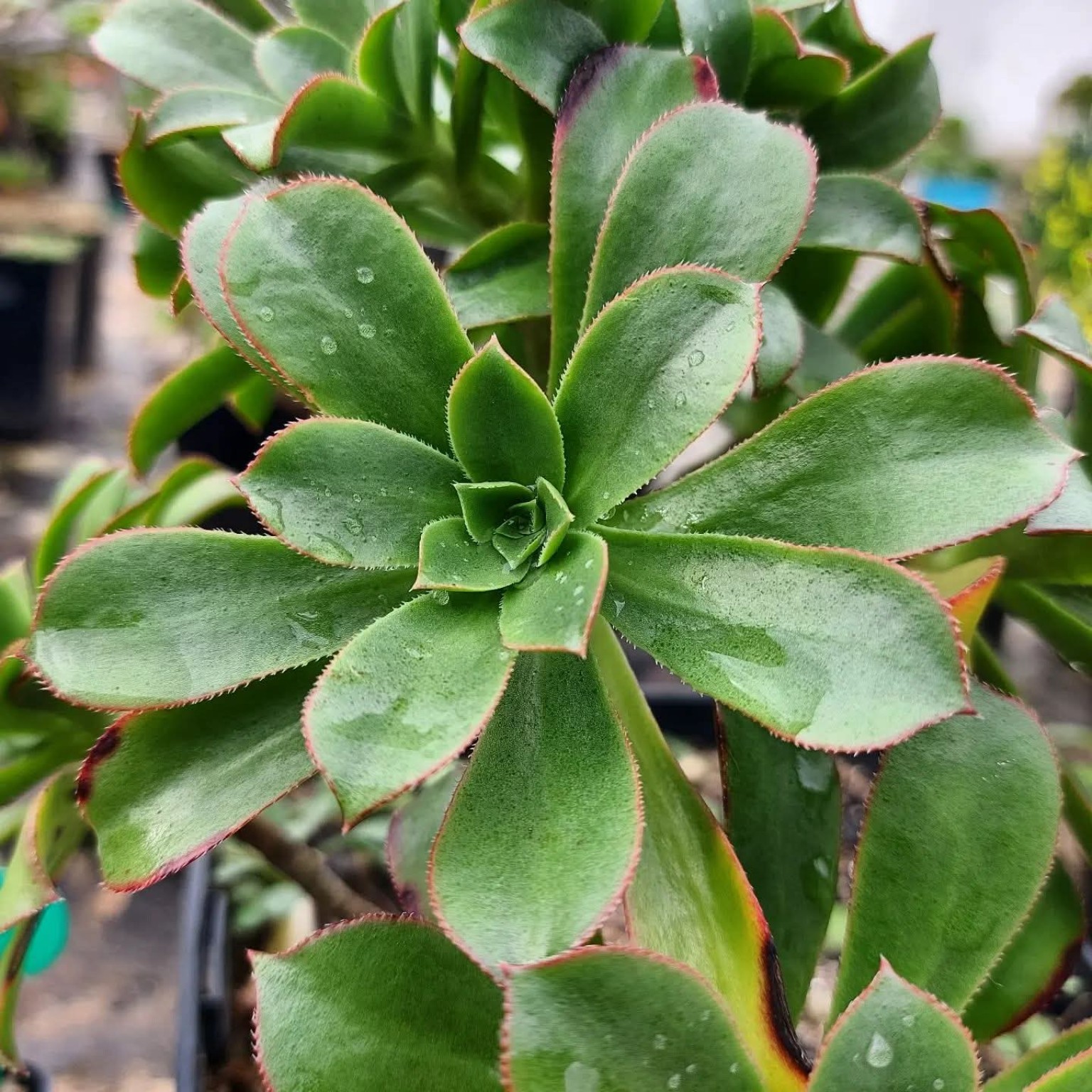
On the rocky slopes of La Gomera, Aeonium decorum unfolds a multitude of little rosettes, almost like flowers made of leaves. Its branching silhouette and delicate colours give it a charm quite different from that of the great solitary-rosetted Aeoniums.
- Reference name
- decorum
- Genus
- Aeonium
- Type
- Botanical taxon
- Country of origin
- Spain
- Growth habit
- Shrubby
- Plant height
- Up to 60 cm
- Rosette diameter
- 5–10 cm
- Branching
- Branching
- Name publication
- 1859
Origin and history
In 1859, the German botanist Carl Bolle published the name Aeonium decorum in Bonplandia (volume 7, p. 241), attributing it to Philip Barker Webb, who had died five years earlier. The botanical authorship Webb ex Bolle preserves the memory of both men. The Latin epithet decorum suggests grace and elegance.
In 1887, the Swiss botanist Hermann Christ transferred the species to Sempervivum under the name Sempervivum decorum. The Royal Botanic Gardens, Kew now accepts the name published in 1859.
The species is native to La Gomera in the Canary Islands, where it inhabits rock crevices and dry cliffs, chiefly between 100 and 900 metres above sea level. In 2001, researchers Jørgensen and Olesen studied it on sunny rocks at San Sebastián. It has also been reported from Tenerife, where its occurrence is far more localised. Accounts differ as to its precise distribution on that island.
In 2008, Ángel Bañares and María Marrero described an isolated miniature form in northeastern La Gomera, naming it Aeonium decorum var. alucense. Their study showed that it retains its small stature even when grown under the same conditions as the typical form. Kew now treats the name as a synonym of the species, although it remains useful for identifying this distinctive population.
More recently, a phylogenetic study published in 2023 identified A. decorum and A. castello-paivae as closely related species within the evolutionary tree examined. That relationship does not mean that one is directly descended from the other.
Chronological milestones
1859 — Reported — Documented name publication.
Botanical description
A little shrub with winding branches
With age, the plant can reach around 60 cm in height. Its slender branches, usually 5–8 mm thick, rise or curve outwards and sometimes hang down. Old leaves leave a network of scars that gives the stems their distinctive texture.
At the tip of each branch sits a relatively flat rosette, 5–10 cm across. As these heads multiply, they create a light, irregular silhouette in which each rosette retains its own shape.
Delicate red margins
The leaves are 2.5–5 cm long and about 1–1.5 cm wide, broadening towards the tip before ending in a point. Their surfaces are smooth and hairless, with just a few tiny cilia scattered along the edges. Together with the elongated shape of the leaves, this helps distinguish the species from the miniature alucense form, whose leaves are smaller and finely hairy.
Ranging from fresh green to deeper green, the foliage often carries a fine red outline. In brighter, drier conditions, that colour may spread across part of the leaf blade in small reddish markings. The rosettes may also tighten, opening again when growth resumes.
Flowering
Have you photographed this cultivar in bloom? Share flowering photographs on the Forum.
Flowering generally takes place from late winter into spring. The airy inflorescences bear small stars with six to eight lance-shaped petals, whitish to pink and sometimes tinged with red. The petals measure approximately 7–8 mm in length. Once flowering is over, the rosette that produced the flower stalk dies, while the other branches continue to grow.
Photographs
Do you grow this cultivar? Help document its shapes and seasonal colours. Share your photographs on the Forum.
Documented descendants of ‘decorum’
Reserved for Premium members
Growing conditions
☀️ Light
This species of sunny rocky habitats appreciates generous light. Acclimatise it gradually to direct sunlight, especially after winter; container-grown plants may benefit from light shade during the hottest summer hours.
💧 Watering
Water thoroughly during active growth, then allow the mix to dry before watering again. Reduce watering when heat slows growth and avoid keeping the roots in constantly damp soil.
🪨 Substrate
Choose an open, predominantly mineral growing medium with a modest organic component, and a container with drainage holes. An airy mix allows the roots to breathe and prevents water from collecting around them.
🌡️ Temperatures
Shelter the plant from frost and prolonged cold rain. A bright, well-ventilated winter position suits it; in summer, avoid prolonged overheating of the container.


