
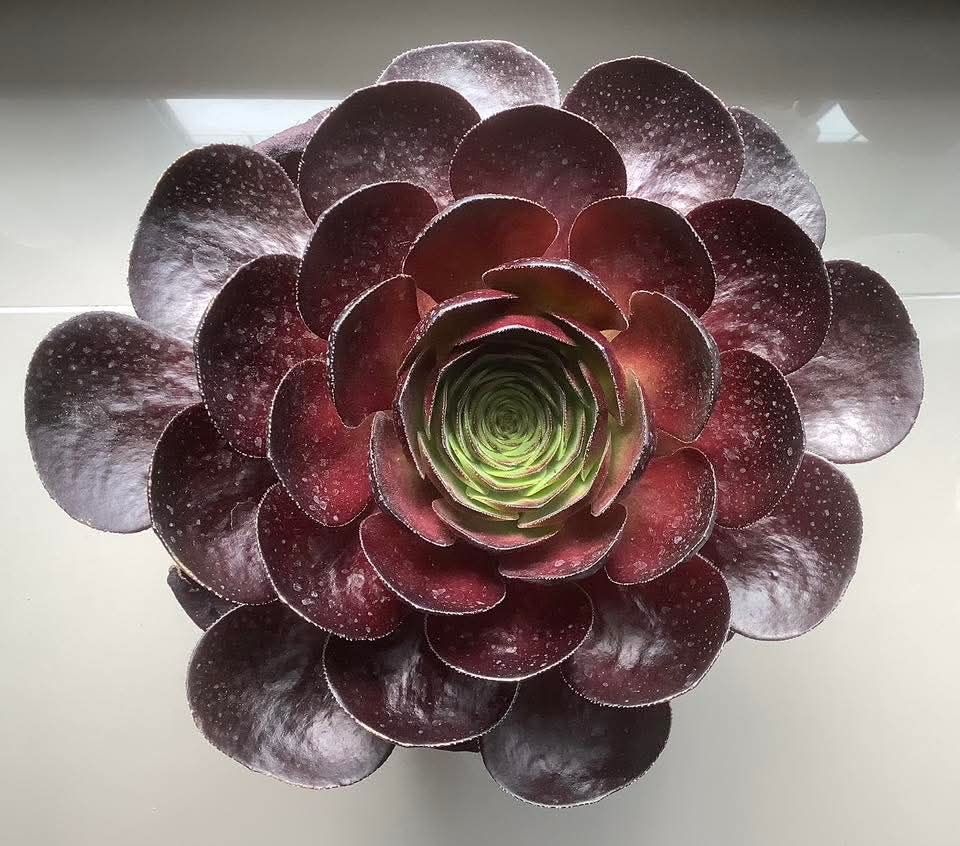
Raised veins catch the light against the deep purple foliage of ‘Destiny’, a remarkable rosette whose beauty won recognition at Chelsea.
- Cultivar name
- × Semponium ‘Destiny’
- Type
- × Semponium horticultural hybrid
- Breeder
- Daniel Michael
- Cross
- 2016
- Habit and size
- Large compact rosette with raised veins; up to 60 cm
- Habit
- Upright rosette
- Parentage
- Sempervivum ‘Green Ice’ (seed parent) × Aeonium ‘Ice Warrior’ (pollen parent)
Family tree
Reserved for Premium members
Origin and history
‘Destiny’ is one of the best-known plants from Daniel Michael’s × Semponium breeding programme. In 2016, he pollinated Sempervivum ‘Green Ice’ with pollen from Aeonium ‘Ice Warrior’. The seedling that would become ‘Destiny’ was selected in 2018 and propagated vegetatively that same year. It gained wider attention after winning Plant of the Year at the RHS Chelsea Flower Show in 2022.
US Plant Patent PP35495, granted on 21 November 2023, records the breeding history and leaf characters that distinguish this plant from other dark-coloured Semponiums, including ‘Sienna’.
Chronological milestones
2016 — ‘Green Ice’ crossed with ‘Ice Warrior’ in Cornwall
2018 — ‘Destiny’ selected by Daniel Michael
2022 — First documented public presentation
21 November 2023 — US Plant Patent PP35495 granted
Botanical description
A large rosette with raised veins
‘Destiny’ first develops a broad, compact, densely leafed rosette on a relatively short stem. Its fleshy leaves are smooth and glossy, widening towards their rounded tips. Raised vein-like markings on the upper surfaces of mature leaves are among its most distinctive features, remaining visible even as the foliage darkens.
‘Destiny’ can develop a rosette up to around 60 cm across. At this scale, its raised veins and the contrast between dark outer leaves and greener centres are especially striking.
Deep colours throughout the year
In strong light, foliage can turn from bright green to a rich, very dark purple. Unlike many purple Aeoniums that become largely green during winter, ‘Destiny’ can retain dark tones throughout the year, with greener centres and raised veins in the cooler season. This contrast gives the leaves their striking appearance.
Branching, propagation and stability
The main rosette becomes substantial before producing offsets, usually after one or two years. Early offsets stay smaller. Cuttings and divisions retain the cultivar’s characteristic traits.
Flowering
Have you photographed this cultivar in bloom? Share flowering photographs on the Forum.
Flowering remains to be documented.
Photographs
Do you grow this cultivar? Help document its shapes and seasonal colours. Share your photographs on the Forum.
Growing conditions
☀️ Light
Provide bright conditions to promote intense purple foliage and a compact growth habit. Acclimatise gradually to direct sun after a period under cover, especially during very hot weather.
💧 Watering
Water during active growth and let the potting mix dry between applications. If growth stalls in intense summer heat, reduce water and feeding rather than trying to force new growth.
🪨 Potting mix
Use an airy, free-draining mix and a stable pot capable of supporting a broad, heavy rosette. Keep drainage clear and provide airflow around the foliage.
🌡️ Temperatures
Protect ‘Destiny’ from prolonged frost and winter wet. For plants in pots, shelter is advisable as temperatures approach 2 °C.


