
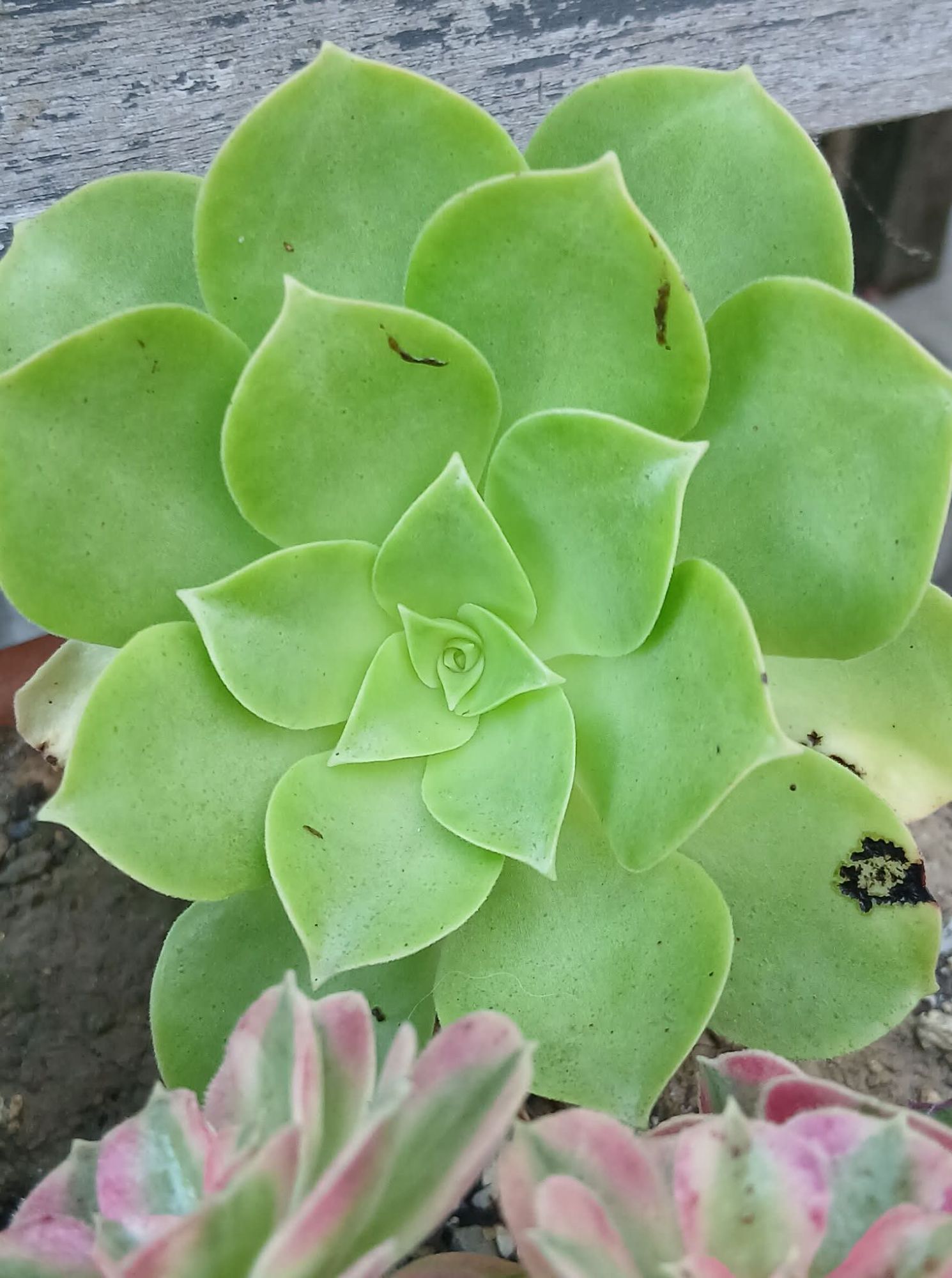
In a collection where variegation and flamboyant colours often steal the show, ‘Jolly Green’ is a lovely reminder of just how beautiful an entirely green Aeonium can be. Its generous growth and fresh, broad rosettes have a charm all their own.
- Reference name
- Jolly green
- Genus
- Aeonium
- Type
- Cultivar
- Country of origin
- United States
- Plant height
- 15.24–45.72 cm
- Rosette diameter
- 20.32–25.4 cm
- Branching
- Branching
- Market introduction
- 1998
Origin and history
The story of ‘Jolly Green’ began in John Bleck’s garden in Goleta, California. Among the many Aeoniums grown by this passionate plantsman, a chance seedling stood out for its generous growth. Bleck selected it and named it after the familiar Jolly Green Giant. San Marcos Growers introduced the plant into cultivation in 1998.
That name began a delightful tradition. Other selections from Bleck’s garden would later carry the ‘Jolly’ name, notably ‘Jolly Clusters’ in 2014 and ‘Jolly Towers’ in 2015. The series reflects a shared garden and naming tradition rather than an established genetic family. The parents of ‘Jolly Green’ remain unknown; connections with Aeonium arboreum and Aeonium canariense have been suggested but not demonstrated.
Chronological milestones
1998 — Documented introduction to the market.
1998 — Reported — Documented event.
Botanical description
A beautiful carpet of green rosettes
Its broad crowns, usually 20–25 cm across, consist of fleshy, elongated leaves with upward-pointing tips. Their uniform green lends the plant a wonderfully fresh appearance. During active growth the rosettes open generously; in summer they become more compact while retaining their predominantly green colouring.
Rather than forming an upright little tree, ‘Jolly Green’ spreads its branches sideways. In favourable Californian garden conditions, it has been described as reaching 30–46 cm in height and spreading almost 1.8 metres across. In containers or under different growing conditions, it can remain much smaller. Its spreading habit is precisely what makes it so appealing in a succulent rock garden.
Flowering
Have you photographed this cultivar in bloom? Share flowering photographs on the Forum.
Small greenish-yellow flowers appear in summer, according to Californian horticultural observations. The flowering rosette then completes its life cycle, while the other branches can continue growing.
Photographs
Do you grow this cultivar? Help document its shapes and seasonal colours. Share your photographs on the Forum.
Winter photographs

Summer photographs

Growing conditions
☀️ Light
Give it plenty of light to maintain compact rosettes. Introduce the plant gradually to direct sunlight, providing shelter during very hot spells.
💧 Watering
Water during active growth once the mix has dried sufficiently. Reduce watering when growth slows in summer.
🪨 Substrate
An airy, free-draining mix in a pot with drainage holes is suitable. A wider container allows room for the branches and showcases its spreading shape.
🌡️ Temperatures
Overwinter in a cool, bright, frost-free position. Avoid prolonged cold, damp conditions.


