
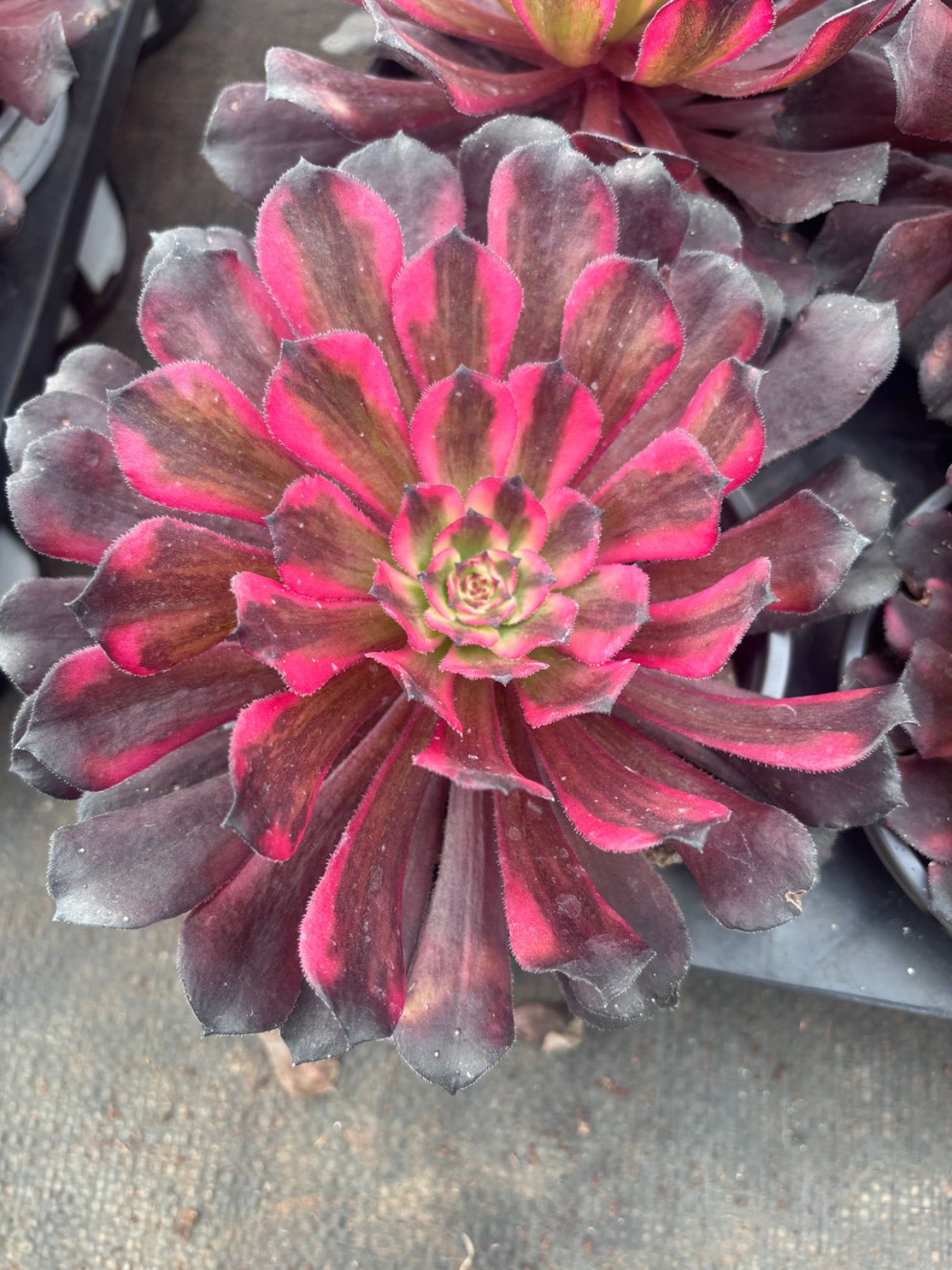
‘Pink King Kong’ retains the bold character of its parent, with an addition of wonderfully striking variegation.
- Reference name
- Pink King Kong
- Other names
- 粉体黑金刚
- Genus
- Aeonium
- Type
- Variegated cultivar
- Mutation of
- Black King Kong
- Earliest documented sale
- 2024
Family tree
Reserved for Premium members
Origin and history
‘Pink King Kong’ is a mutation of ‘Black King Kong’. It is encountered under the Chinese name 粉体黑金刚 (Fěntǐ Hēi Jīngāng) and is reported to have been in commerce by 2024. The name Purple Kingkong has also been associated with this plant, but its equivalence remains unconfirmed. The date of emergence and the discoverer are unknown.
Chronological milestones
2024 — Reported — Earliest documented sale.
Botanical description
An intense contrast of pink and purple
Broad, spoon-shaped leaves unfold into a generous rosette. At its heart, a little green mingles with the pink of the young leaves; further out, the foliage takes on purplish-brown tones that can be almost black.
That dark foliage sets off magnificent bands of fuchsia pink. Sometimes the pink sweeps along the sides of the leaf, leaving a darker tip. No two leaves are quite alike, and the result is a truly spectacular Aeonium.
Flowering
Have you photographed this cultivar in bloom? Share flowering photographs on the Forum.
The flower colour and the form of the inflorescence have yet to be documented.
Photographs
Do you grow this cultivar? Help document its shapes and seasonal colours. Share your photographs on the Forum.
Growing conditions
☀️ Light
Provide generous light and gradually acclimatise pale leaf areas to sunshine.
💧 Watering
Water during active growth after the mix has dried, then space out watering during intense heat.
🪨 Substrate
A porous mix with a mineral component encourages airflow around the roots.
🌡️ Temperatures
Protect the foliage from excessive heat and keep the plant frost-free in winter.


