
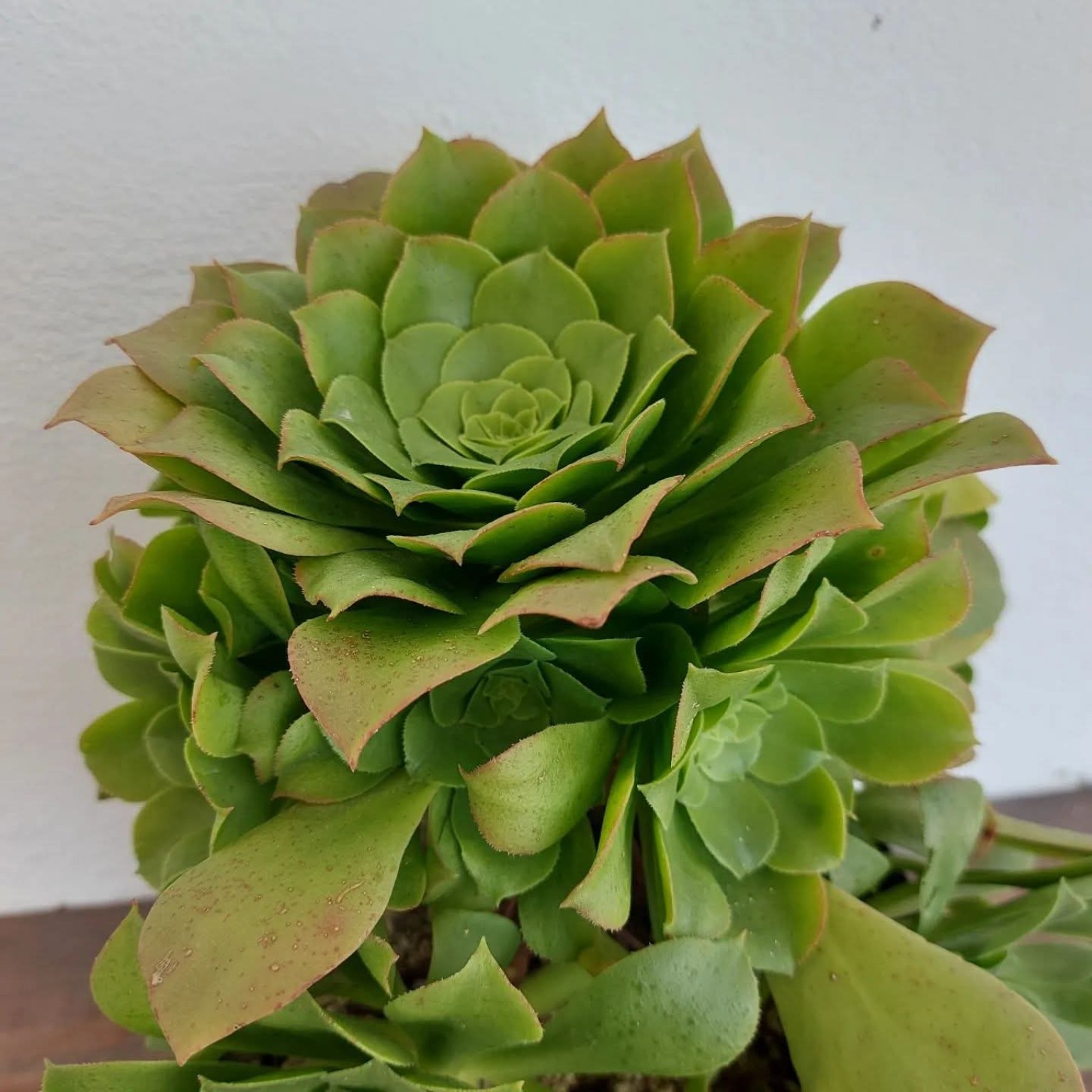
High on La Gomera, the meeting of two species produced an Aeonium that now bears the name of a botanist. Its beautiful emerald rosettes remind us how natural crosses enrich the diversity of the genus.
- Reference name
- × beltranii
- Other names
- Aeonium × beltranii
- Genus
- Aeonium
- Type
- Botanical hybrid
- Country of origin
- Spain
- Growth habit
- Flat rosette
- Rosette diameter
- Up to 30 cm
- Branching
- Rare offsets
- Name publication
- 1986
- Parents
- decorum × canariense subsp. latifolium
Family tree
Reserved for Premium members
Origin and history
In March 1981, Ángel Bañares collected this hybrid at El Bailadero on La Gomera, 950 metres above sea level. He described it in Vieraea in 1986 and dedicated it to Esperanza Beltrán Tejera, professor of botany at the University of La Laguna. The original description names Aeonium decorum and Aeonium subplanum as its parents; Kew now uses Aeonium decorum × Aeonium canariense subsp. latifolium. The two formulations reflect taxonomic treatments of the second parent and should not be mistaken for an entirely new hypothesis about the cross.
Chronological milestones
1986 — Documented original publication.
Botanical description
Beautiful emerald-green rosettes
In the wild, Bañares described a branching plant with slightly flattened rosettes around 12–15 cm across. The leaves broaden towards their tips, end in a point and carry a few marginal cilia; a reddish tint highlights their edges. Much larger rosettes, reaching 30 cm or more, have been reported in cultivation. Older leaves develop red accents in summer. Some cultivated plants produce few offsets and retain a dominant rosette for a long time, in contrast to the branching habit described in the wild.
Flowering
Have you photographed this cultivar in bloom? Share flowering photographs on the Forum.
The original description records stalked flowers with eight or nine petals, pale greenish yellow to almost white. Their pointed petals are hairy, and the flowers form a branching inflorescence reaching about 35 cm long. Flowering is reported in March and April in the wild.
Photographs
Do you grow this cultivar? Help document its shapes and seasonal colours. Share your photographs on the Forum.
Growing conditions
☀️ Light
Provide generous light and gradually acclimatise the plant to direct sun.
💧 Watering
Water during active growth after the mix dries, adjusting watering as growth slows in summer.
🪨 Substrate
An airy, free-draining mix and a stable pot suit its large rosettes.
🌡️ Temperatures
Protect container-grown plants from frost and prolonged cold damp conditions.


