
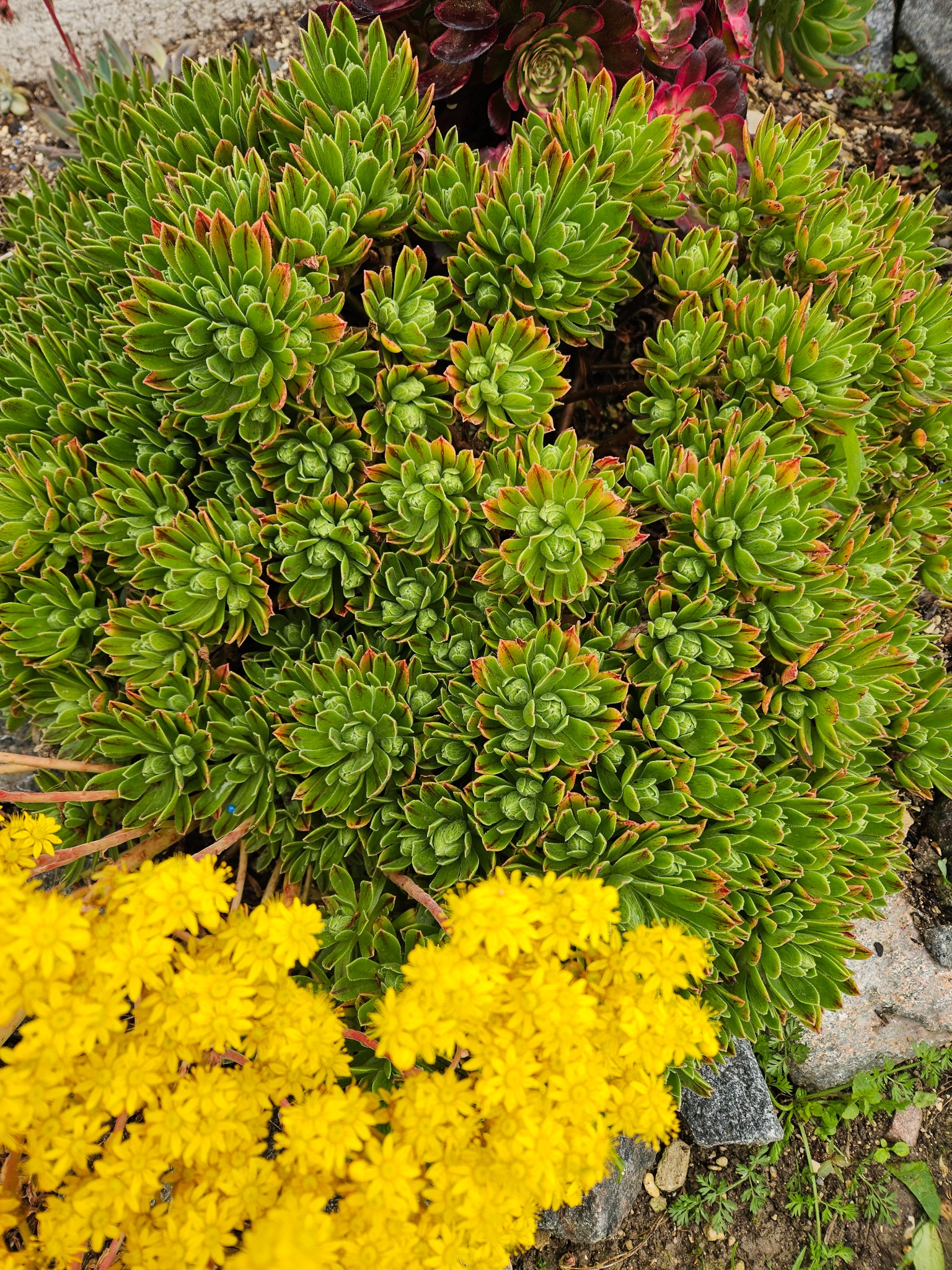
More than two centuries after appearing in collections, this delightful little Aeonium has lost none of its charm. Its tiny rosettes and golden flower clusters make it an intriguing companion throughout the seasons.
- Reference name
- x hybridum
- Genus
- Aeonium
- Type
- Botanical taxon
- Country of origin
- Spain
- Growth habit
- Bushy
- Plant height
- Up to 15 cm
- Rosette diameter
- About 5 cm
- Branching
- Branching
- Name publication
- 1821
Family tree
Reserved for Premium members
Origin and history
In 1820, a hybrid plant was recorded in Mr Law’s collection. From this specimen, believed to have arisen in cultivation, Adrian Hardy Haworth published the name Sempervivum ciliare var. hybridum in 1821. Robert Lloyd Praeger provided an illustrated account in 1932. In 1969, Gordon Douglas Rowley established the combination Aeonium × hybridum. The accepted parentage is Aeonium simsii × Aeonium spathulatum, also recorded by Kew. The name × barbatum, still encountered in horticulture, is considered incorrect by the International Crassulaceae Network. Kew also records the hybrid as native to Gran Canaria, a distribution distinct from the history of the cultivated specimen.
Chronological milestones
1821 — Documented event.
1969 — Publication of a new botanical combination.
Botanical description
A little carpet of rosettes
Branches spread from the base, carrying rosettes around 5 cm across. Praeger described a clump reaching about 15 cm tall and 30 cm wide. The outer leaves spread while the centre remains upright. A closer look reveals brownish markings underneath and tiny translucent structures along the leaf edges, distinct from the fine cilia of Aeonium simsii. In summer the rosettes can close into small cylindrical heads.
Flowering
Have you photographed this cultivar in bloom? Share flowering photographs on the Forum.
The open golden flowers are approximately 15 mm across, with eight to ten petals. Their flat-topped clusters usually bloom in May and June, although flowering at other times has been reported.
Photographs
Do you grow this cultivar? Help document its shapes and seasonal colours. Share your photographs on the Forum.
Mutations of ‘x hybridum’
Direct mutations

Documented descendants of ‘x hybridum’
Reserved for Premium members
Growing conditions
☀️ Light
Provide bright light and gradually acclimatise the plant to direct sun.
💧 Watering
Water as the mix dries during growth. Reduce watering when the rosettes close in summer.
🪨 Substrate
Choose a free-draining mix in a relatively broad container suited to the spreading branches.
🌡️ Temperatures
Protect container-grown plants from frost and prolonged cold damp conditions.


