Origin:
A mutation of Aeonium ‘Madeira Rose’ (‘Halloween’).
Known names:
‘Halloween White‘ (the most widely used name), ‘Dragon Fruit’?, 万圣节白锦.
Creation date / Breeder:
Marketed from 2020 onward in China.
Botanical description
Aeonium ‘Halloween White’ is a shrubby variegated Aeonium whose foliage displays a relatively regular pattern.
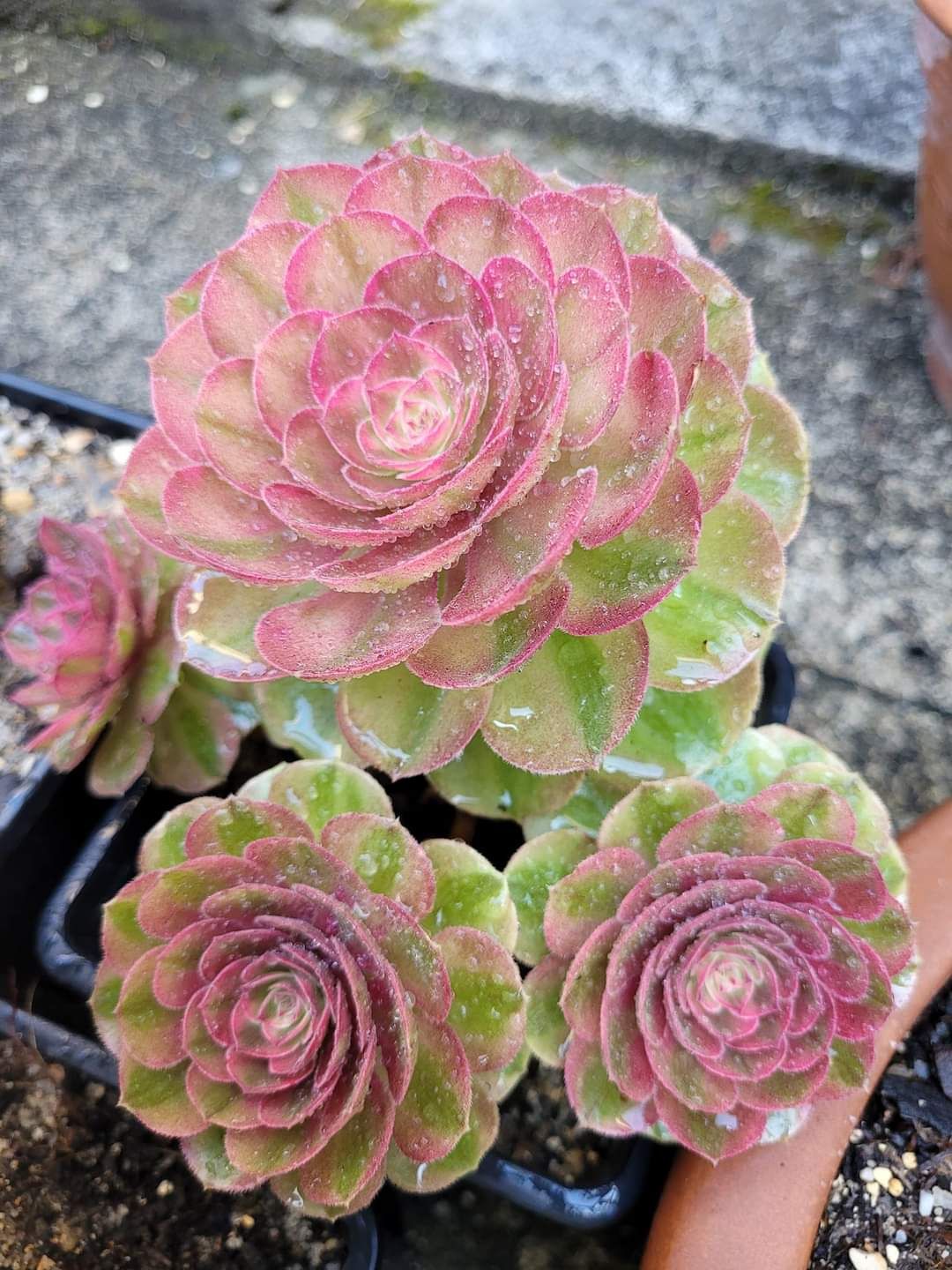
In winter, when light levels are lower, the leaves generally display:
- a broad green central band;
- two white to cream lateral bands;
- a fine pink to red edge around the leaves.
This combination of colors is one of the cultivar’s most interesting characteristics.
Unlike forms with very pure white areas, however, the lateral bands of ‘Halloween White’ tend to develop a greenish tint in places, depending particularly on growing conditions and the season.
This feature can give the foliage a slightly cream, greenish or “off-white” appearance.

Color that intensifies with light
Like many variegated Aeoniums, the appearance of ‘Halloween White’ changes considerably with its environment.
As light levels, temperatures and water stress increase, the leaf margins progressively take on pink and then red shades.
In some specimens, this coloration can become particularly intense and cover a large proportion of the peripheral leaf areas.
The contrast between the green center, cream areas and red margins can then become spectacular.
This seasonal development explains why the same plant may look very different in winter and summer.
‘HALLOWEEN WHITE’ AND ‘LOVE IN THE FALLEN CITY’
This comparison is particularly important because the two Aeoniums may be confused, especially when growing conditions greatly alter their coloration.
The main difference: the amount of white
Aeonium ‘Love in the Fallen City’ generally displays much whiter and purer lateral areas, with less chlorophyll.
In ‘Halloween White’, the lateral areas are more likely to show cream, pale-yellow or greenish shades.
This difference may be especially visible in winter, when temperatures are cool and light is less intense.
In summary:
‘Halloween White’ → cream/white with a tendency to become greenish.
‘Love in the Fallen City’ → purer white with significantly less chlorophyll.
This distinction is currently one of the best visual criteria for separating the two cultivars when grown under comparable conditions.

‘Love in the Fallen City’ is whiter and contains much less chlorophyll than ‘Halloween White’.
Variegation that can become very low in chlorophyll
One important point to monitor in ‘Halloween White’ is its tendency to develop very heavily variegated forms.
Some rosettes may gradually lose a large proportion of their chlorophyll and become almost albino.
This development is not without consequences.
Because chlorophyll is essential for photosynthesis, a major reduction in chlorophyll-bearing tissue may cause:
- slower growth;
- increased sensitivity to unfavorable conditions;
- a reduced ability to withstand periods of stress.
A highly variegated plant may therefore be visually spectacular while being considerably less vigorous than a specimen with more green tissue.
This characteristic should be taken into account when selecting plants for preservation or propagation.
Growth and branching
Available observations indicate that ‘Halloween White’ has slow to moderate growth.
Its ability to produce offsets also appears moderate.
This relatively limited vigor may become more pronounced when the plant develops rosettes with very little chlorophyll.
Conversely, a specimen retaining enough green tissue may grow much more regularly.
WINTER PHOTOS


SUMMER PHOTOS


CONTINUE EXPLORING


