
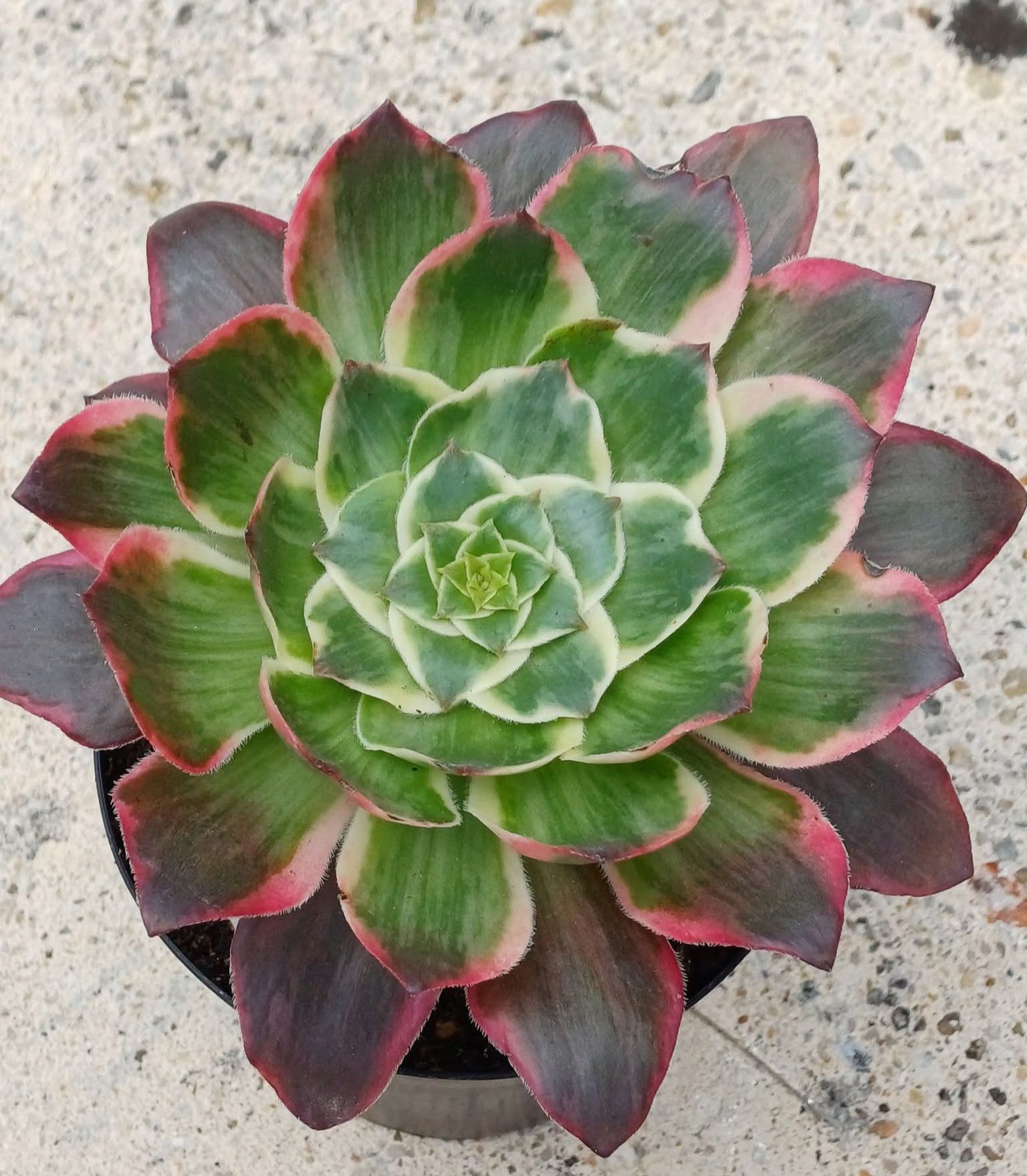
There is something mesmerising about the ‘gaze’ of ‘Voodoo Devil’s Eye’. Long leaves patterned in green, ivory and pink surround a commanding rosette whose colours seem to draw the eye towards its centre. It is an unusually evocative name for an unforgettable plant.
- Reference name
- Voodoo Devil's Eye
- Other names
- Voodoo Devil · Voodoo Devil Eye · Devil Eyes · Evil Eye · Voodoo Gray · Gray Voodoo · Devil · Grey Voodoo · Devil’s Eye · 恶魔之眼 · Devil's Eye
- Genus
- Aeonium
- Type
- Variegated cultivar
- Probable mutation of
- Voodoo Green
- Growth habit
- Tree-like
- Plant height
- About 150 cm
- Rosette diameter
- About 35 cm
- Branching
- Sparsely branching
- Date
- 2024 — Earliest documented sale
Family tree
Reserved for Premium members
Origin and history
The ‘Voodoo’ family has given rise to a remarkable variety of sports, from pale ivory forms to deeply darkened rosettes. ‘Voodoo Devil’s Eye’ appears particularly close to ‘Voodoo Green’. A spontaneous mutation of that cultivar is considered probable, but the direct lineage has not been demonstrated. Similarity in such a rich family is an intriguing clue, not a substitute for evidence.
The name takes us to Asia. The Chinese 恶魔之眼, also written 惡魔之眼 (Èmó zhī Yǎn), means ‘the demon’s eye’. The singular English ‘Devil’s Eye’ is its most faithful rendering. ‘Voodoo Devil Eye’, ‘Devil Eyes’, ‘Evil Eye’, ‘Voodoo Gray’ and ‘Gray Voodoo’ have also appeared in horticultural circulation.
An Asian publication dated 18 July 2024 records the Chinese name. That is a valuable trace of its history, but it does not establish when the sport arose or who first discovered it. Much of the earliest chapter of this cultivar’s story remains to be uncovered.
Chronological milestones
2024 — The Chinese name 惡魔之眼, meaning “the devil’s eye”, appears in an Asian publication dated 18 July 2024. The date of the plant’s selection remains unknown.
Botanical description
In winter, the thick, elongated leaves carry a generous green central area framed by cream-to-ivory sectors. The variegation is not always a series of even bands: little streaks and marbled marks add depth, while a delicate pink or red line follows the edges. The effect is strikingly graphic without needing dazzling colours.
As the light strengthens, the margins deepen from pink to red, and some of the foliage takes on richer tones. It is then easy to understand the name ‘Devil’s Eye’: the contrasting colours seem to pull the viewer towards the centre of the crown.
A rosette with an extraordinary gaze
Uneven markings make the leaves look almost hand-painted. Green, ivory and reddish outlines combine differently from one rosette to the next. Looking at winter and summer photographs together is particularly rewarding, because the character of the plant evolves without losing its distinctive pattern.
The commanding scale of the ‘Voodoo’ family
This is no dainty, miniature succulent. Like its relatives, it may develop a sturdy trunk more than 1 m (3.3 ft) tall, sometimes approaching 1.5 m (5 ft), with a terminal rosette around 35 cm (14 in) wide. The effect is especially imposing because the plant often forms relatively few branches.
Growth can be lively under favourable conditions, but offsets are not abundant. For collectors, every new rosette is therefore worth noticing.
A young selection with more to tell us
Early reports suggest sensitivity to very hot summers, especially where heat and excess moisture coincide. We also have much to learn about the stability of its variegation and its long-term growth. The observations listed below are questions for future cultivation, not final judgments on this intriguing plant.
- the stability of its variegation;
- its resistance to extreme climatic conditions;
- its actual propagation capacity;
- its long-term development in cultivation.
Flowering
Have you photographed this cultivar in bloom? Share flowering photographs on the Forum.
Photographs
Do you grow this cultivar? Help document its shapes and seasonal colours. Share your photographs on the Forum.
Summer photographs


Growing conditions
☀️ Light
Provide a bright position with gentle morning sun and shelter from intense direct sunlight in the hottest part of summer.
💧 Watering
Water during active growth once the substrate has dried adequately. Reduce watering in summer, particularly when growth slows, to limit excessive moisture in hot weather.
🪨 Substrate
Use an airy, highly free-draining growing medium in a container with drainage holes, avoiding stagnant water at the roots.
🌡️ Temperatures
Protect from frost and cold, damp conditions. In summer, avoid overly hot or enclosed positions and provide good airflow.
Help us enrich this profile
An observation, a correction or photographs? Share your knowledge with us.


