
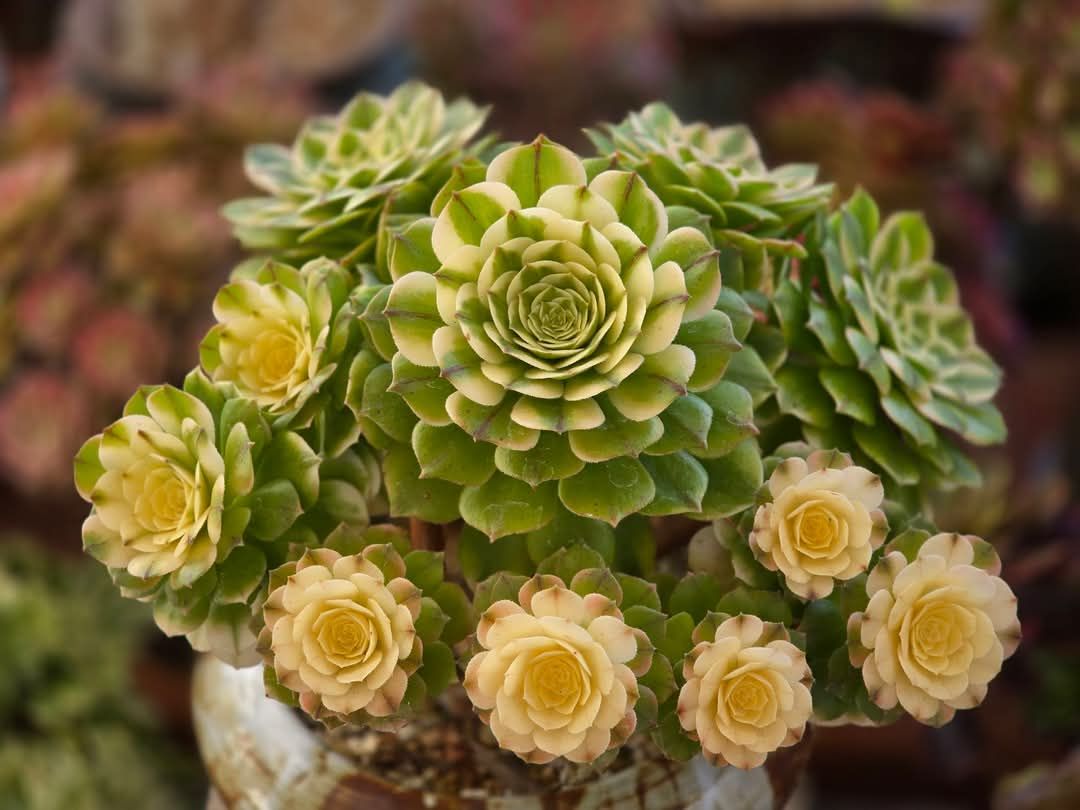
‘Eliza’ has the elusive beauty of a variegated plant that changes its mood with the seasons. Green and cream can develop deep brown tones as the light strengthens, giving the rosette an unexpected elegance. Its story also begins with a name that must not be confused with another.
- Reference name
- Eliza
- Other names
- Elizabeth · 伊丽莎白 · Elizabeth Variegated · 伊莱莎
- Genus
- Aeonium
- Type
- Variegated cultivar
- Probable mutation of
- Madeira Rose
- Growth habit
- Shrubby
- Branching
- Branching
- Date
- 2024 — Earliest documented sale
Family tree
Reserved for Premium members
Origin and history
‘Eliza’ is a relatively recent arrival in Asian collections. It has been described as a possible mutation of ‘Madeira Rose’, but the proposed ancestry remains unproven: no clearly identified primary observation yet establishes the relationship. Its appearance in Chinese trade in 2024 is a useful documentary landmark, not proof that the mutation first arose that year.
The names make the story even more interesting. ‘Eliza’ is the reference name retained here, although ‘Elizabeth’ and the Chinese 伊丽莎白 also occur. A single letter matters enormously: ‘Elisabeth’, spelled with an s, refers to a different, older Aeonium hybrid associated with Aeonium lindleyi and the Jardin exotique et botanique de Roscoff. Those two horticultural stories must not be merged simply because their names look alike.
The original discoverer, exact place of selection and earliest propagation history are still unknown. That leaves room for future collectors’ accounts, particularly as the plant is still new in many European collections.
Chronological milestones
2024 — ‘Eliza’ is reported for sale in 2024; it is likely to have arisen as a mutation of ‘Madeira Rose’.
Botanical description
‘Eliza’ carries a green centre flanked by creamy-yellow leaf sectors. In winter and softer light, its pattern is quite restrained, almost familiar among variegated Aeoniums. As the seasons change, however, the rosette begins to show a personality of its own.
Under stronger light, dark brown pigmentation may appear near the centre of the leaves and travel towards their tips. Not every leaf responds equally: some remain bright while others deepen. The contrast between cream bands and shadowed centres can be wonderfully rich.
Green and ivory, with unexpected brown shadows
The change is neither uniform nor tied to a fixed calendar. Light, temperature and the condition of the plant affect how the pigments develop. On a well-grown rosette, the darkened centre can make the pale bands seem almost luminous.
A lively plant still revealing its mature form
Early growers report fairly active growth and an average willingness to produce new heads. What kind of shrub will ‘Eliza’ become after many years? That question is part of the pleasure of a young cultivar: the earliest lovely specimens do not yet tell its whole life story.
When the variegation becomes almost too beautiful
Some growers have reported plants gradually losing much of their green tissue, with very pale rosettes that may become less vigorous. How often this happens, and whether it is stable, are not yet clear. It would be misleading to present this as the inevitable fate of every ‘Eliza’.
For a collector, however, it is a useful reminder that the whitest head is not always the strongest — and a detail worth following over time.
Flowering
Have you photographed this cultivar in bloom? Share flowering photographs on the Forum.
No distinctive floral characteristics have yet been documented for ‘Eliza’. As with other Aeoniums that flower terminally, the flowering rosette completes its cycle while other, unflowered branches may continue growing.
Photographs
Do you grow this cultivar? Help document its shapes and seasonal colours. Share your photographs on the Forum.
Winter photographs


Summer photographs

Growing conditions
☀️ Light
Place the plant in a bright position to maintain a compact rosette and encourage coloration. Acclimate it gradually to direct sunlight and monitor the cream areas, which are more susceptible to sunburn.
💧 Watering
Water according to the actual activity of the plant and how quickly the pot dries. Allow the growing medium to dry sufficiently between waterings and reduce watering when growth slows in hot weather.
🪨 Substrate
Use a very free-draining mix that allows excess water to escape quickly. Good root aeration is particularly important for highly variegated or weakened plants.
🌡️ Temperatures
Protect the plant from frost. During hot weather, provide good ventilation and adjust watering if growth slows.


