
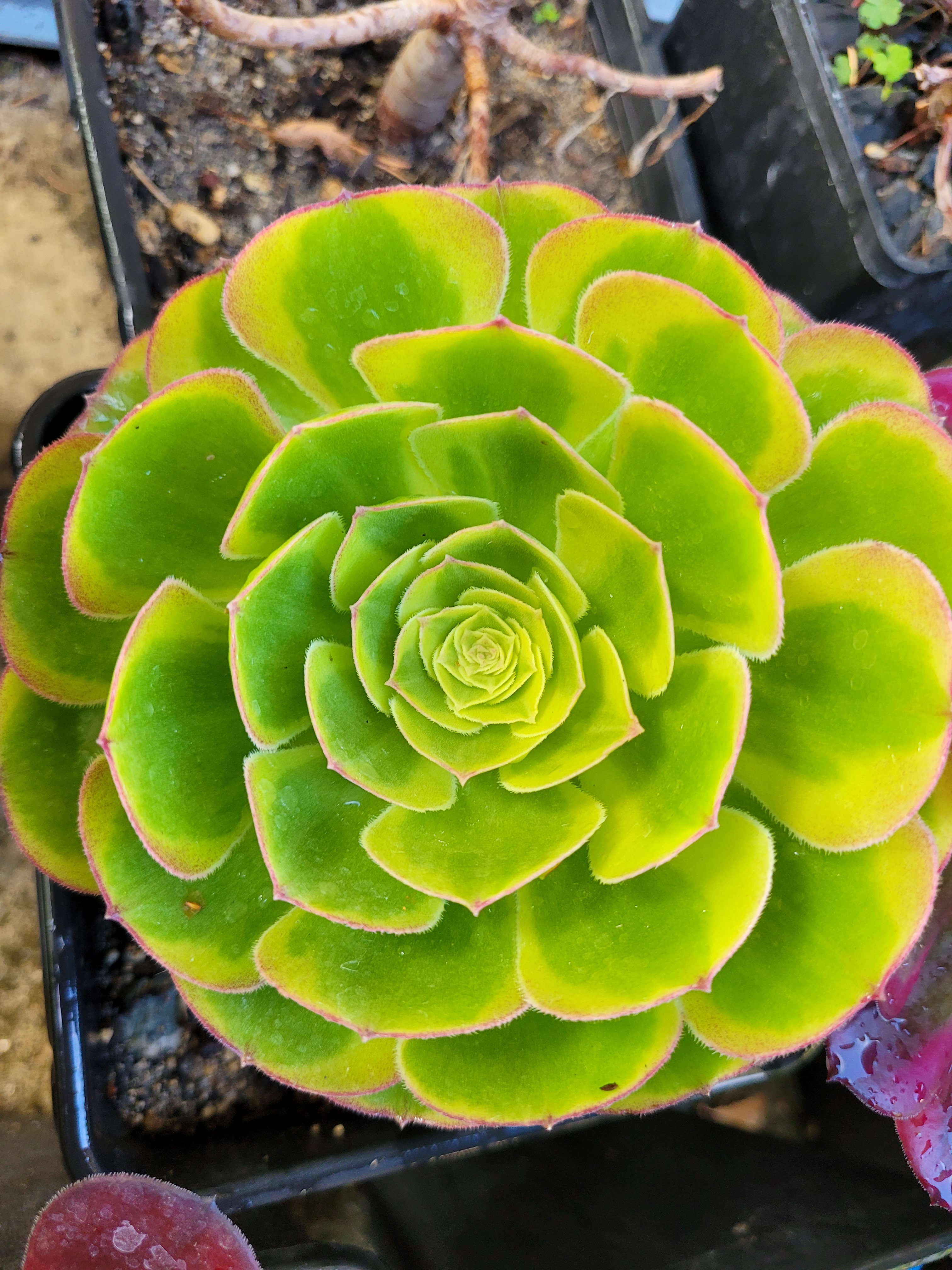
Within the ‘Madeira Rose’ lineage, ‘Milky White’ develops cream, sometimes distinctly yellow, variegation that changes with the seasons despite its milky-white name.
- Reference name
- Aeonium ‘Milky White’
- Other names
- Halloween cream brocade, Halloween Milk variegata, Halloween variegated 3, Milk White, Halloween Milky White, Halloween Milk White, Halloween Milk, Halloween Cream
- Type
- Variegated cultivar
- Probable mutation of
- Aeonium ‘Madeira Rose’
- Date
- 27 June 2022 — documented publication
- Growth habit
- Cluster of rosettes
- Genus
- Aeonium
- Country of origin
- China
Family tree
Reserved for Premium members
Origin and history
A variegated form associated with Aeonium ‘Madeira Rose’, commonly sold as ‘Halloween’ in the Asian trade. It is described as a mutation within this lineage.
First documented occurrence: recorded in China by 27 June 2022. The first commercial introduction and exact date of appearance remain unknown; the originator has not been identified.
Aeonium ‘Milky White’ belongs to the group of variegated forms sold within the Aeonium ‘Madeira Rose’ / ‘Halloween’ lineage. Its Chinese name 万圣节奶白锦 explicitly associates it with ‘Halloween’ and milky-white variegation.
A Chinese publication dated June 27, 2022, featuring plants photographed by a collector in Jiangyin, already mentions 万圣节奶白锦 and its abbreviated name 奶白. This establishes its presence by that date, without identifying when it arose or was first offered for sale.
Several English trade names developed as the plant spread internationally. Despite the name ‘Milky White’, plants described and photographed on the site often show cream to yellow bands that can turn distinctly yellow in good light.
Chronological milestones
2022 — A Chinese publication dated 27 June already shows this cream-variegated form under the names 万圣节奶白锦 and 奶白. Its first sale date remains unknown.
Botanical description
More golden than its name suggests
‘Milky White’ belongs to the ‘Madeira Rose’ lineage and retains its shrubby habit. Its leaves have green centres flanked by cream-to-yellow bands, often edged with a fine red line. Despite the name, its variegation can become distinctly yellow.
Warm colours through the year
Winter foliage is mostly light green and cream. Brighter light strengthens the yellow and brings red to the margins, sometimes spreading across part of the blade. Growth is relatively quick for a variegated cultivar, with moderate offset production. Seasonal colour changes should not automatically be mistaken for reversion.
Flowering
No flowering characteristics specific to this cultivar have been documented. A flowering rosette is monocarpic: it gradually dies after blooming, while nonflowering branches may continue to grow.
If you have documented this cultivar in bloom, share your observations or photographs via the Forum bubble beside the Flowering heading.
Photographs
Winter photographs


Summer photographs


Growing conditions
☀️ Light
Provide plenty of light to maintain compact rosettes and encourage contrast. Acclimate gradually to direct sun and protect pale leaves during the hottest hours in summer.
💧 Watering
Water during active growth, allowing the mix to dry sufficiently between applications. Reduce watering as growth slows in summer, taking account of rosette development, heat and how quickly the pot actually dries.
🪨 Substrate
Choose an airy, well-draining mix and a container with drainage holes. The mix should release excess water quickly while allowing roots to develop during active growth.
🌡️ Temperatures
Keep frost-free. In very hot weather, provide good airflow and reduce exposure to scorching sunlight. No specific minimum temperature tolerance has been established for ‘Milky White’.


