Origin:
Derived from a mutation of Aeonium leucoblepharum.
Known names:
‘Maple Leaf’ — the principal international name —, ‘Maple Leaves’, ‘Leucoblepharum Variegated’, ‘Leucoblepharum Variegata’, ‘Leucoblepharum Yemen Variegata’, ‘Aeonium leucoblepharum Yemen Form Variegated’, and 枫叶 / 楓葉 (Fēngyè), the Chinese name meaning “maple leaf.” The spelling ‘Maple Leave’ is a grammatical error frequently found in listings.
Creation date / Breeder:
The cultivar was reported in 2022 and was probably distributed from China. The earliest precisely dated post found to date is from August 21, 2022 and uses the Chinese name 枫叶. The breeder, original nursery, and exact discovery date remain unknown.
Botanical description
Aeonium ‘Maple Leaf’ is a shrubby, variegated Aeonium whose morphology remains fairly close to that of its botanical parent.
The plant forms modest-sized rosettes on relatively slender stems. Its leaves are long, narrow, and pointed, with the characteristic outline of forms associated with A. leucoblepharum.
In the botanical species, the leaves can develop pronounced pink coloration in bright light and generally display a darker central vein or band.
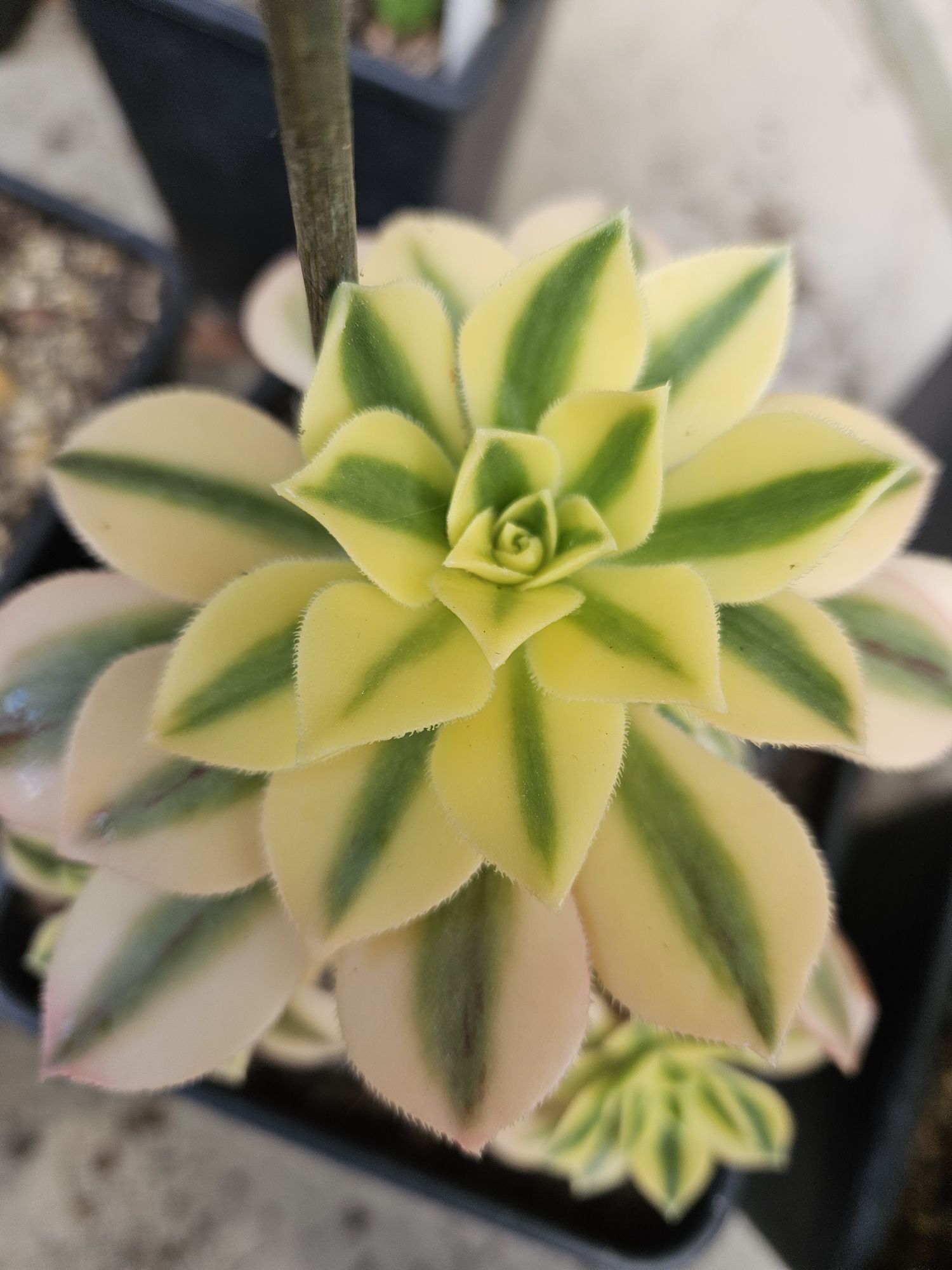
In ‘Maple Leaf’, this leaf architecture is combined with variegation expressed mainly as three longitudinal zones:
- a green central band;
- two cream to pale-yellow lateral bands;
- and margins that may develop pink to red tones.
Color strongly influenced by light
In winter, when light levels are relatively low, ‘Maple Leaf’ generally displays foliage dominated by green and cream.
The central band remains green, while the lateral areas take on a soft cream color. The leaves then have a comparatively understated appearance.
As light intensity increases, the more colorful character of the cultivar gradually emerges.
The lateral bands turn pink, orange, and sometimes red, with an intensity directly influenced by exposure, temperature, and growing conditions.
Comparing the same plant in winter and during the brighter growing season can therefore reveal a considerable difference in color.
Especially slender foliage
One of the most notable characteristics of ‘Maple Leaf’ is its slender, tapered foliage.
The leaves are relatively narrow and end in a distinct point, strongly recalling the morphology of some A. leucoblepharum populations.
This outline distinguishes it from many shrubby variegated aeoniums with much broader and fleshier leaves.
The foliage may also have ciliate margins, a typical feature of the botanical species. The name leucoblepharum itself refers to these characteristic “white eyelashes” along the leaf edges.
Growth and offset production
Early cultivation observations indicate rather slow growth, especially when conditions are not optimal.
Its ability to produce offsets, however, appears excellent. A well-established plant may quickly develop several branches and numerous small rosettes.
This is useful to collectors because a slow-growing Aeonium is not necessarily difficult to propagate when it offsets freely.
A plant that requires excellent drainage
The main difficulty with ‘Maple Leaf’ appears to involve moisture management more than resistance to heat or sunlight.
A very free-draining growing medium that allows water to leave the pot quickly is therefore recommended. This is especially important when temperatures are low or the plant enters a slower phase of growth.
Horticultural recommendations for Aeonium leucoblepharum follow the same approach: a light, perfectly drained growing medium, moderate watering, and nearly dry conditions during less favorable periods.
Extra care is also advisable for container-grown plants: a medium that remains wet for several days can quickly become problematic for the roots.
‘Maple Leaf’ and the question of the Yemeni A. leucoblepharum
This is probably one of the most interesting aspects of the cultivar’s history.
For many years, forms identified as Aeonium leucoblepharum from Yemen and East Africa were grouped under the same name. Recent taxonomic research shows that the situation is more complex.
In 2025, Aeonium lavranosii-newtonii was formally described as a distinct species. This plant from northern Yemen had long been cultivated and distributed as Aeonium leucoblepharum. It is distinguished in part by a persistent red central band and pinkish-orange foliage.
At the same time, major botanical databases continue to recognize Aeonium leucoblepharum as a species broadly distributed in East Africa and Yemen.
It is therefore premature to state with certainty that the parent of ‘Maple Leaf’ corresponds to the Yemeni form historically identified as Aeonium leucoblepharum. Precise documentation of its origin, and possibly the study of its flowers and additional botanical traits, would be particularly valuable.
Flowering could provide useful evidence
Flowering is one feature that could help clarify the origin of ‘Maple Leaf’.
As in other aeoniums, an inflorescence emerges from the center of a mature rosette, and that rosette generally dies after flowering. Aeonium leucoblepharum flowers only rarely. Available botanical descriptions report yellow flowers with usually 8 to 10 petals.
For a cultivar whose botanical origin remains under discussion, carefully photographing the flowers, inflorescence, and individual floral parts could therefore provide especially valuable evidence.
WINTER PHOTOGRAPHS


SUMMER PHOTOGRAPHS


CONTINUE EXPLORING


