Origin:
Derived from a mutation of Aeonium ‘Athena’, itself derived from Aeonium ‘Blushing Beauty’.
Known names:
‘Parakeet’ — the most widely used name.
Creation / commercialization date:
Its appearance or initial distribution is generally placed in 2021 in China, although no primary source has been found. Its existence is documented by November 19, 2022, at the latest.
Botanical description
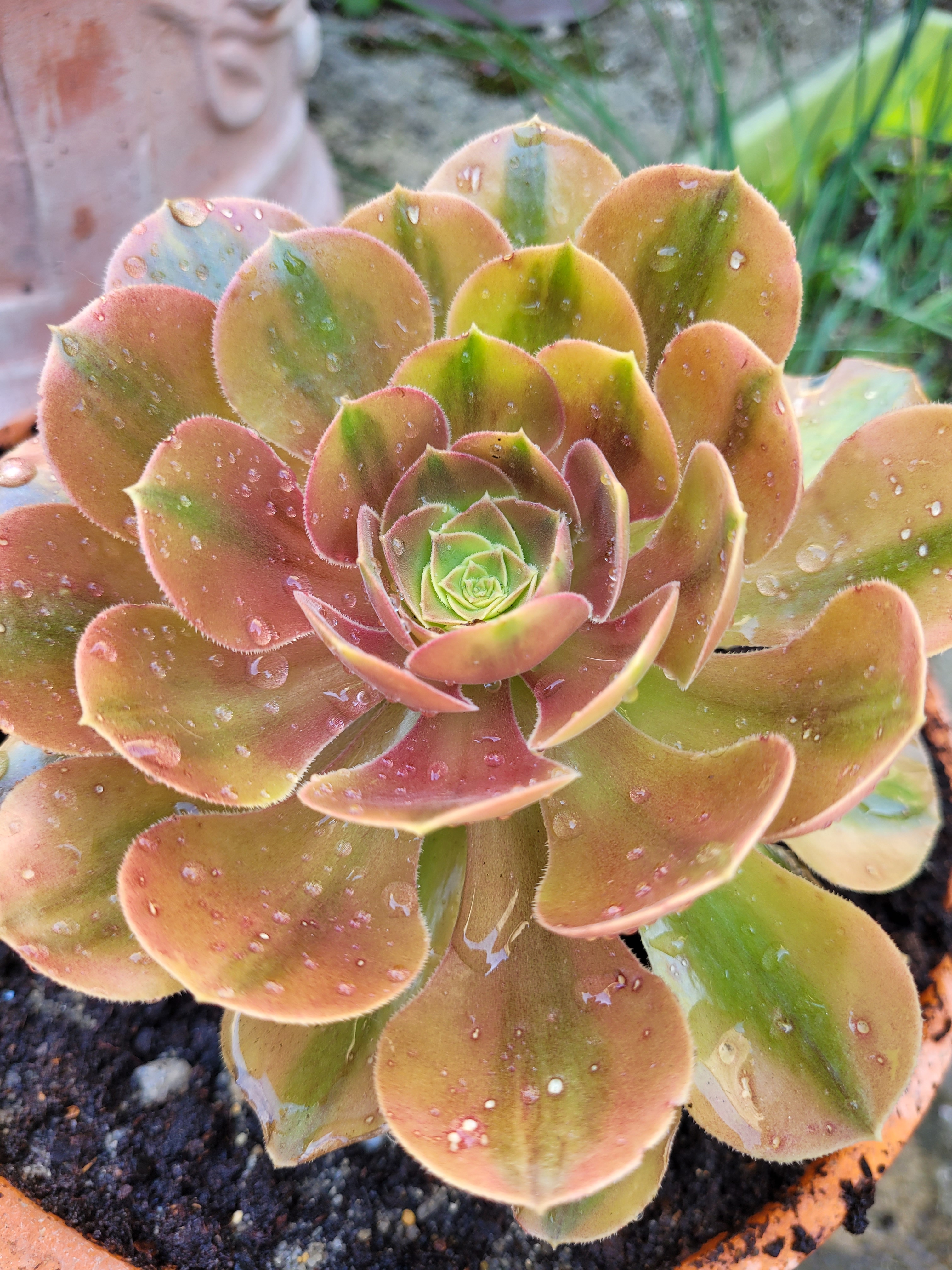
Aeonium ‘Parakeet’ is a variegated shrubby Aeonium with a branching habit, notable primarily for the highly distinctive development of its variegation.
In winter, when light levels are relatively low, the rosette generally displays a broad green central area. This may occupy a large part of the leaf blade, sometimes making the variegation appear rather subtle.
The lateral areas are especially interesting: unlike many variegated aeoniums with relatively regular bands, those of ‘Parakeet’ are often irregular and vary in width from one leaf to another.
They are generally pale yellow to cream, sometimes with pinkish tones.
This irregularity is one of the features used to identify the mutation.
Highly distinctive coloration
As light levels and temperatures rise, the behavior of ‘Parakeet’ becomes much more spectacular.
The lateral areas begin to develop pink, orange, and brown tones, while the green center gradually appears to recede.
On well-exposed plants, the contrast can become particularly pronounced, combining:
- green at the center of the leaves;
- creamy yellow in the variegated areas;
- pink and red on the most exposed parts;
- orange and brown on older leaves.
This color palette is fairly unusual among variegated aeoniums and contributes greatly to the appeal of the plant.
As with other aeoniums, however, the intensity of these colors depends heavily on light, temperature, the plant’s water status, and its acclimation.
Growth and offset production
Initial observations indicate fairly slow growth.
Its ability to produce offsets appears satisfactory, however, which is valuable in such a rare cultivar.
Stability still requires monitoring
This is probably one of the most important aspects to document over the coming years.
Initial observations in collections indicate that some plants may produce reversions, meaning rosettes in which the variegation decreases markedly or disappears.
This phenomenon is not unusual among variegated aeoniums. A rosette that has returned to solid green contains more chlorophyll and may therefore grow more vigorously than strongly variegated parts.
To preserve a cultivar such as ‘Parakeet’, it is therefore advisable to monitor the different offsets regularly and favor those that retain the plant’s typical characteristics.
At this stage, however, the limited number of plants observed does not support the conclusion that ‘Parakeet’ is inherently unstable.
Potential sensitivity remains difficult to assess
The rarity of ‘Parakeet’ also makes it difficult to establish a genuinely reliable cultivation profile.
Current information comes mainly from private collections and a few growers. There is therefore still too little experience to determine its precise tolerance of:
- heat;
- summer humidity;
- intense sun exposure;
- drought;
- or low temperatures.
Initial observations suggest that a degree of sensitivity and imperfect stability may explain, at least in part, its limited distribution.
Cultivation: a few precautions
Like other variegated Aeonium cultivars, ‘Parakeet’ prefers a very free-draining growing medium and good air circulation.
Bright light is essential for the best coloration.
During periods of high heat, aeoniums naturally slow their activity and may enter dormancy. Watering should then be less frequent, especially when the growing medium remains moist for several days.
In winter, by contrast, light becomes particularly important for maintaining compact growth and preserving the expression of the variegation.
As with all aeoniums, ‘Parakeet’ must, of course, be protected from frost.
An extremely rare mutation
Aeonium ‘Parakeet’ is ultimately a rather paradoxical cultivar.
Its particularly original combination of colors distinguishes it from many other variegated aeoniums. Yet several years after its appearance, it remains extremely difficult to find in collections.
It is now listed among the mutations of the ‘Blushing Beauty’ lineage, alongside numerous other selections such as ‘Athena’, ‘Princess’, ‘Pink Witch’, and ‘Riverstones’, all of which achieved commercial success unlike ‘Parakeet’.
WINTER PHOTOGRAPHS


SUMMER PHOTOGRAPHS


CONTINUE EXPLORING


