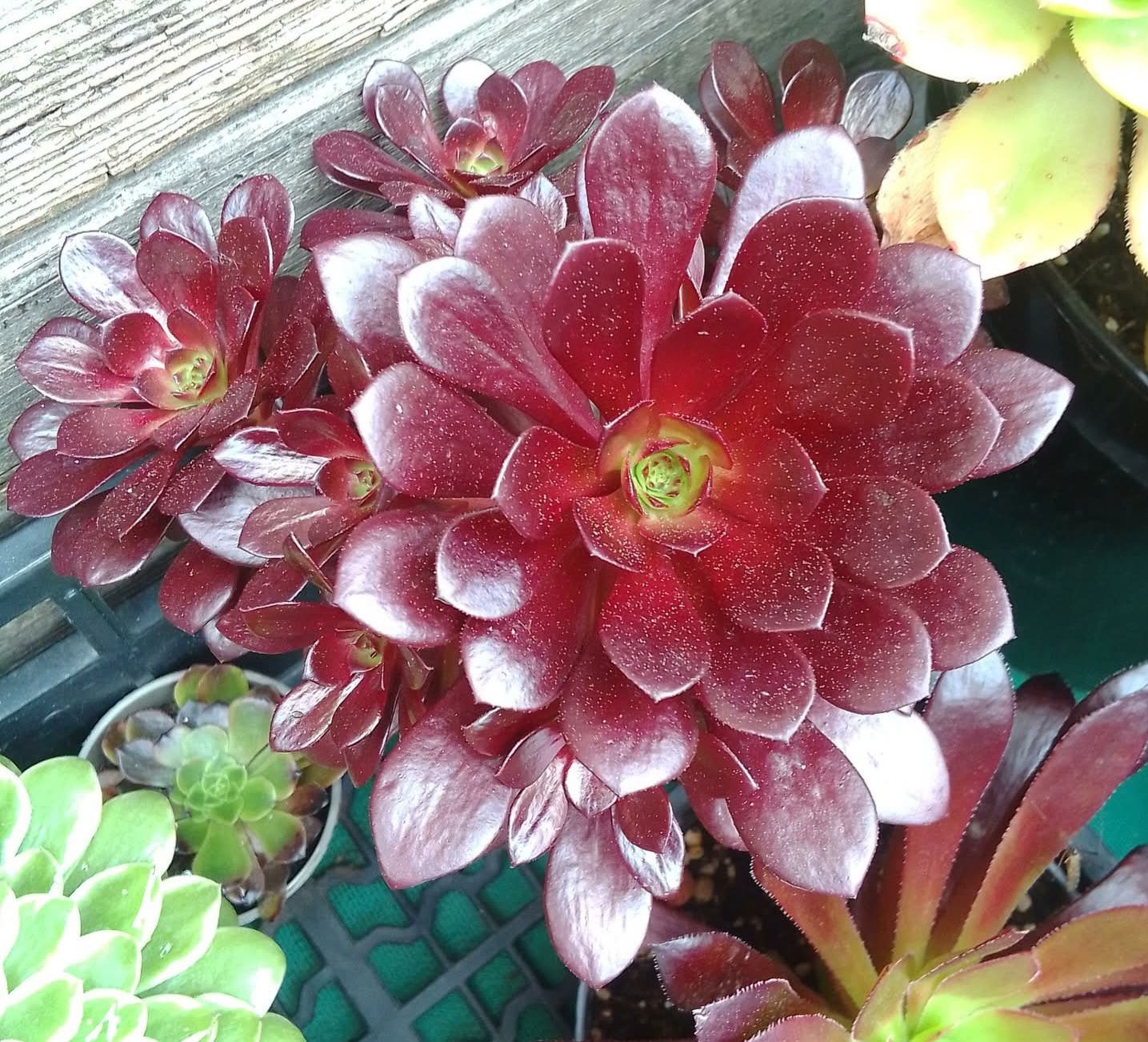
Origin: Cultivar discovered and selected in Bettrum, Germany, by Franz Eret, among young Aeonium plants whose material was, according to Hanfried Haage, identical to that grown by Kakteen-Haage under the name ‘Black Night’. The name under which these plants were grown by Franz Eret is not known. Its exact genetic origin remains undetermined.
Known names: ‘Rotkäppchen’ is the name Franz Eret gave the plant. The correct German spelling is Rotkäppchen. The transcription Rotkaeppchen may be used when the character ä is unavailable. The spellings Rotkappchen, Rottkapchen, and Rottkäppchen should be regarded as spelling distortions rather than synonyms. Rotkäppchen literally means “Little Red Riding Hood” in German; Little Red Riding Hood and Petit Chaperon rouge are therefore translations of the name and, to date, not established horticultural synonyms.
Creation / commercialization date: Exact discovery date unknown. After Franz Eret selected it, the plant was passed to the German nursery Kakteen-Haage, which propagated and distributed it. Its presence in the Kakteen-Haage general catalog is documented from 2018.
Origin and history
The plant was discovered by Franz Eret in Bettrum, Germany, among young Aeonium plants. According to Hanfried Haage, the material grown by Eret was identical to that marketed by Kakteen-Haage under the name ‘Black Night’. Haage nevertheless specifies that Eret had not obtained these plants from their nursery and that he does not know under what name they were grown by Eret. One individual differed enough from the others to attract Eret’s attention; he kept and selected it, then named it ‘Rotkäppchen’.
Franz Eret later passed the plant to the German nursery Kakteen-Haage, which propagated it and played an important role in its horticultural distribution.
The exact genetic origin of ‘Rotkäppchen’ is more difficult to establish.
The connection with ‘Black Night’ therefore rests on Hanfried Haage’s observation that Eret’s material was identical to the material distributed under that name by Kakteen-Haage, rather than on any documented ‘Black Night’ label used by Eret. Haage also recalls that the name ‘Black Night’ was probably assigned within the nursery to an Aeonium received from the Netherlands without a cultivar name. He now considers it possible that this plant was ‘Zwartkop’, but this retrospective identification is based on his recollection and is not supported by any document found to date. It must therefore remain a hypothesis.
Hanfried Haage has also retrospectively suggested botanical explanations for the differences observed between ‘Rotkäppchen’ and the material called ‘Black Night’ at Kakteen-Haage: smaller rosettes, shorter and thicker leaves, and the absence of conspicuous marginal hairs. However, different species have been mentioned as a possible parent over the course of the exchanges, including Aeonium haworthii and later Aeonium percarneum. These varying suggestions are not supported by known genetic or documentary evidence and therefore cannot establish a parentage.
At this stage, it is therefore impossible to determine whether ‘Rotkäppchen’ represents a mutation, an atypical seedling, or the result of spontaneous hybridization. Hanfried Haage’s recollections are particularly valuable for reconstructing the history of the plant’s distribution and the names used at Kakteen-Haage, while his suggestions concerning botanical identity or parentage should be treated as leads requiring independent confirmation.
The chronology of its distribution is better established. In the 2018 Kakteen-Haage general catalog, ‘Rotkäppchen’ was offered as a “pretty red form of arboreum.” In the 2020 catalog, the nursery also described it as very slow-growing. That catalog clearly distinguished ‘Rotkäppchen’ from ‘Black Night’, with both listed at the same time under different reference numbers.
Botanical description
General description
Aeonium ‘Rotkäppchen’ is a shrubby cultivar characterized by its small, compact, strongly colored rosettes.
The leaves are relatively short, thick, and closely packed. They give the rosettes a denser, stockier appearance than those of many Aeonium in the arboreum group. This morphology is one of the traits that distinguishes it from ‘Black Night’.
Its coloration is also characteristic. In sufficiently bright light, the leaves develop dark red to reddish-brown tones, sometimes very intense. Younger growth at the center of the rosette may retain greener or lighter shades.
Another noteworthy trait is the relatively glabrous appearance of its leaves, whereas ‘Black Night’ has visible leaf cilia. This morphological difference has contributed to questions about the true origin of ‘Rotkäppchen’.
Seasonal changes
As with many strongly pigmented Aeonium, the color of ‘Rotkäppchen’ varies noticeably with growing conditions.
During the growing period and under lower light levels, the rosettes show more green or brownish tones. The actively growing center is generally lighter.
As light levels and temperatures rise, the red pigments become more visible. The leaves may gradually develop reddish-brown to dark red tones, especially on the most exposed areas.
In summer, when growth slows, the rosettes generally become more compact. The exact intensity of the coloration nevertheless depends strongly on exposure, temperature, and the plant’s hydration.
Growth and branching
‘Rotkäppchen’ is a relatively slow-growing Aeonium.
The plant gradually develops a branching habit with several rosettes. Its size and outline may vary with age and growing conditions, but its development generally remains more compact than that of the large classic forms of Aeonium arboreum.
Particular sensitivities
No sensitivity genuinely specific to ‘Rotkäppchen’ is currently documented well enough to be stated with confidence.
Flowering
No feature specific to the flowering of Aeonium ‘Rotkäppchen’ has yet been sufficiently documented.
As in other aeoniums, each rosette is monocarpic: it gradually dies after flowering, while the other branches normally continue to develop.
Growing conditions
☀️ Light
Bright light is important for achieving the compact habit and, especially, the characteristic red coloration of ‘Rotkäppchen’.
A plant grown in insufficient light will tend to become greener and less compact. The transition to strong sunlight should nevertheless be gradual, especially after overwintering or growing under cover.
💧 Watering
During active growth, watering may be regular provided the growing medium is allowed to dry sufficiently between waterings.
When summer temperatures become high and growth slows, water requirements decrease sharply. Watering should then be spaced out and adjusted to the plant’s actual condition rather than following a fixed schedule.
🪨 Substrate
A very free-draining growing medium is recommended so excess water drains quickly and the roots remain well aerated.
This precaution is especially important during cool, damp periods and in summer when root activity slows.
🌡️ Temperatures
‘Rotkäppchen’ must be protected from frost. In the absence of experimental data supporting a specific minimum hardiness, it is preferable to keep temperatures above 32°F (0°C).
During periods of intense heat, the plant may slow its growth considerably. Watering should then be reduced and adjusted to its level of activity.
WINTER PHOTOGRAPHS


SUMMER PHOTOGRAPHS


CONTINUE EXPLORING


