
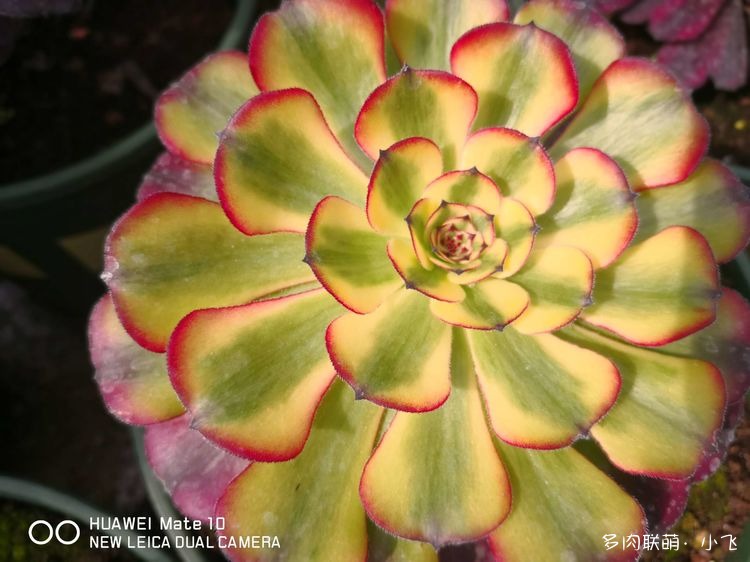
‘Meiya’ arose when new variegation appeared on ‘Morticia’ (‘Black Loli’), a reversion of ‘Mardi Gras’.
- Reference name
- Aeonium ‘Meiya’
- Other names
- Maya, Mei Ya, Meya, Meija, Hong Fu, Hongfu, Black Loli Wheel Brocart, Black Loli Variegata, 美娅, 美婭
- Type
- Variegated cultivar
- Mutation of
- Aeonium ‘Morticia’
- Growth habit
- Shrubby, branched
- Rosette diameter
- Can exceed 20 cm
- Date
- 2015 — Documented record
- Genus
- Aeonium
- Country of origin
- China
- Branching
- Branching
Family tree
Reserved for Premium members
Origin and history
In 2015 nursery grower Wang Baozhong retained a dark reversion of ‘Mardi Gras’ in Lijiang. In November 2017 several rosettes developed new variegation and four heads were propagated. Xiaofei published this history in December 2018. The plant was originally named ‘Hong Fu’ before becoming ‘Meiya’.
In the mid-2010s, Aeonium ‘Mardi Gras’ was still rare and particularly expensive in China. In 2015, Wang Baozhong was asked to acquire a batch of plants to serve as mother plants. Among the twenty-five specimens received, one stood out because it had completely lost its variegation.
This dark plant, considered to have little commercial value, was set aside. Its leaves gradually became broader, rounder, and larger than those of Aeonium ‘Mardi Gras’. Its appearance then matched what Chinese growers call ‘Black Loli’, a form generally associated with Aeonium ‘Morticia’.
Two years later, in late November 2017, several rosettes spontaneously developed new variegation. Four heads showing the mutation were immediately removed and rooted as cuttings. A fifth rosette, initially still green, began producing variegated leaves in February 2018.


During 2018, Wang propagated these first plants intensively. Observations over several generations showed that the new variegation was passed on relatively consistently. Leaf-cutting trials are even reported to have produced several dozen true-to-type young plants, a fairly unusual feature among aeoniums.


This sequence explains why Aeonium ‘Meiya’ is sometimes classified among mutations of Aeonium ‘Morticia’ and sometimes among those of Aeonium ‘Mardi Gras’. These accounts are not truly contradictory: Aeonium ‘Meiya’ does descend from Aeonium ‘Mardi Gras’, but its variegation reappeared on an intermediate dark reversion.
Chronological milestones
2015 — In Lijiang, Wang Baozhong notices a dark reversion among 25 ‘Mardi Gras’ plants imported from the United States and sets it aside. This is the plant on which ‘Meiya’ will emerge.
November 2017 — In late November, several rosettes on the dark reversion kept by Wang Baozhong become variegated. Four heads are removed and rooted as cuttings.
2018 — Wang Baozhong propagates the first plants and observes the stability of their new variegation.
February 2018 — In February, a fifth rosette begins producing variegated leaves.
Botanical description
A shrub with large rosettes
‘Meiya’ develops large, regular rosettes that may exceed 20 cm, with leaves broader, rounder and fleshier than in ‘Mardi Gras’. Mature outer leaves may approach 4 cm in width.
Variegation during active growth
In autumn and winter, leaves combine pale-green centres, broad cream-yellow to yellowish-white sectors and pink margins. With brighter light the edges turn pink and later ruby red while the growing centre remains brighter.
A misleading summer transformation
During dormancy or prolonged dryness, older foliage may become dark red, purple or nearly black, making the variegation almost disappear. New growth normally restores its green-and-cream sectors when active growth resumes. This pigment change should not be mistaken for a permanent genetic reversion.
How does ‘Meiya’ differ from ‘Hongyan’?
‘Meiya’ generally has broader, rounder leaves; ‘Hongyan’ often retains a more consistently vivid summer colour, whereas ‘Meiya’ can become very dark. Its growth and offset production are good, with variegation observed through multiple generations of vegetative propagation.
Flowering
If you have documented this cultivar in bloom, share your observations or photographs via the Forum bubble beside the Flowering heading.
Photographs
Winter photographs


Summer photographs


Mutations of ‘Meiya’
Direct mutations

Growing conditions
☀️ Light
Provide bright light and acclimate the pale sectors gradually to direct sun.
💧 Watering
Water during growth after sufficient drying; reduce watering during summer dormancy.
🪨 Substrate
Use a well-aerated, free-draining medium in a pot with drainage holes.
🌡️ Temperatures
Protect from frost and persistently wet, cold weather.


