
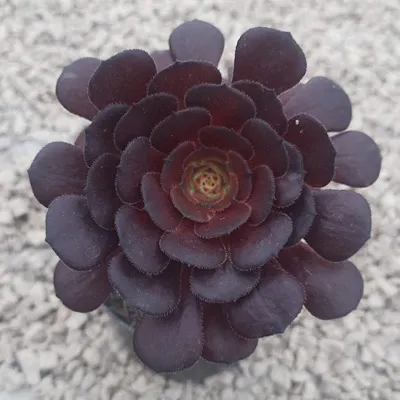
A nearly black rosette, broad rounded leaves and a centre that turns green as the seasons change: ‘Morticia’ tells the remarkable story of a variegated plant that lost its variegation before giving rise to fresh colours.
- Reference name
- Morticia
- Genus
- Aeonium
- Type
- Cultivar
- First documented record
- November 2017
Family tree
Reserved for Premium members
Origin and history
The story begins with Aeonium ‘Mardi Gras’, the variegated hybrid raised in 2007 by Renée O’Connell. On some plants a shoot loses its variegation and develops fully pigmented foliage. This horticultural reversion is known as ‘Morticia’: it is neither a wild species nor a newly bred seedling hybrid.
In China it is called 黑萝莉 (Hēi Luólì, ‘Black Loli’), sometimes translated as ‘Dark Lolita’. The Western name recalls the Addams Family, though the person who named the plant is unknown. It already existed in November 2017: Xiaofei’s account published on 27 December 2018 describes the discovery of ‘Meiya’ on a reverted plant of this lineage in Lijiang, Yunnan. This documents its existence, not the date when it first appeared.
Collectors now know this plant particularly well through its variegated mutations, including ‘Dark Goddess’ and ‘White Moonlight’. Despite their close relationship, ‘Morticia’ is their unvariegated source plant, not a synonym. Losing its variegation was not the end of the lineage’s story.
Chronological milestones
November 2017 — Xiaofei’s account dated 27 December 2018 reports that ‘Meiya’ was observed in November 2017 on 黑萝莉 (Morticia) in Lijiang.
Botanical description
From green to almost black
The fleshy, relatively broad leaves have rounded tips, a tiny point and finely ciliate margins. They form open, regular rosettes that can become sizeable on mature specimens. Leaf thickness and rosette width depend on growing conditions.
During active growth the centre may be green, with red-edged outer leaves. With stronger light and as summer rest approaches, the leaves develop burgundy, deep red and almost black-purple tones. The crowns tighten and their oldest outer leaves gradually dry.
Colour alone is not enough to identify ‘Morticia’: look at the rounded leaf shape and the absence of stable variegated bands. It can produce lateral offsets; stem cuttings help preserve the reverted form when it remains true to type.
Flowering
Alex Pin’s photograph from April 2026 shows several flower stalks bearing dense clusters of bright yellow stars on dark branches. The flowering rosette completes its life cycle, while non-flowering branches may continue growing. Timing varies with cultivation.

Photographs
Do you grow this cultivar? Help document its shapes and seasonal colours. Share your photographs on the Forum.
Winter photographs

Summer photographs

Mutations of ‘Morticia’
Direct mutations


Documented descendants of ‘Morticia’
Reserved for Premium members
Growing conditions
☀️ Light
Bright light encourages dark pigmentation, but acclimatise the rosettes gradually to direct sun and shelter them from scorching heat.
💧 Watering
Water during growth after the mix has dried; reduce watering as the rosettes tighten in summer.
🪨 Substrate
A free-draining mix and a pot with drainage holes help prevent moisture around the roots.
🌡️ Temperatures
Protect from frost and prolonged cold, wet conditions. Provide ample ventilation in summer.


