Origin:
A mutation of Aeonium ‘Morticia’, also referred to in older Chinese names as ‘Black Loli’.
Known names:
‘White Moonlight’ (official name), ‘Moonlight’ (the most widely used name), 白月光 (Bái Yuèguāng), ‘Pure Moonlight’, Morticia var. form white, Morticia variegate 2, 黑萝莉白 (Hēi Luólì Bái), 黑萝莉超白锦 (Hēi Luólì Chāobái Jǐn), 黑萝莉锦 (Hēi Luólì Jǐn), Dark Loli the White, and Black Loli Super White Variegated.
Creation / discovery date:
First half of 2020, in a horticultural greenhouse in Yunnan, China. Larger-scale propagation began in May 2021 under the impetus of Ou Mu Horticulture, before the Chinese name 白月光, “White Moonlight,” was assigned in late 2021.
Origin and history of Aeonium ‘Moonlight’
The history of Aeonium ‘Moonlight’ is relatively well documented for a recent Chinese cultivar, thanks to the account of Xiaofei, a Chinese Aeonium grower and specialist from Yunnan.
According to his account, the original plant appeared during the first half of 2020 in the greenhouse of a succulent grower in Yunnan. Xiaofei states that he unfortunately has no photograph or document of the plant at the exact time of discovery, so the precise circumstances in which the mutation appeared remain unknown.
It is a particularly white variegated mutation of Aeonium ‘Morticia’, which explains some early names such as ‘Morticia var form white’ and ‘Black Loli Super White Brocade’.
In May 2021, about a year after its discovery, Ou Mu Horticulture helped propagate it to gradually increase the number of available plants.
In late 2021, the new selection was officially given the Chinese name 白月光, generally translated as ‘White Moonlight’.
The cultivar was subsequently referred to increasingly often simply as Aeonium ‘Moonlight’.
Why the name ‘White Moonlight’?
The story behind the name is unusual and worth preserving.
According to Xiaofei, the name ‘White Moonlight’ was originally devised for another variegated Aeonium.
Wang Xinyu is reported to have felt that the name suited this new white mutation of Aeonium ‘Morticia’ especially well. It was therefore ultimately assigned to this cultivar.
The inspiration came from the title of a Chinese song that was very popular at the time, 《白月光与朱砂痣》, which can be translated approximately as “White Moonlight and the Vermilion Mole.” (listen here)
This story also allows the period when the name was chosen to be dated fairly precisely.
Botanical description
Aeonium ‘Moonlight’ is a shrubby variegated Aeonium derived from a mutation of Aeonium ‘Morticia’.
It retains some of its parent’s general morphology but is immediately distinguished by its particularly pale variegation, combining mainly green, cream-white, and various shades of red.
The distribution of pigments varies considerably with the season and the plant’s physiological state.
This ability to change its appearance is one of the defining characteristics of ‘Moonlight’.
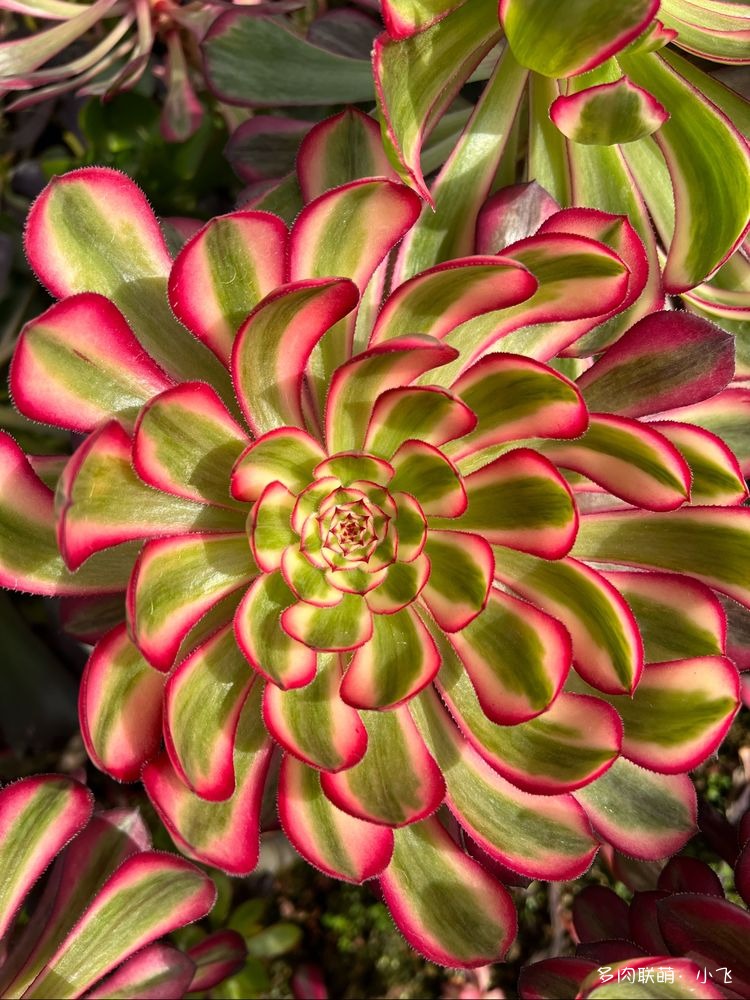
Aeonium ‘Moonlight’ during active growth
When the plant enters active growth, the leaves generally become longer and more open.
Xiaofei describes a particularly characteristic arrangement of colors at this stage.
The chlorophyll-rich center of the leaf is bright emerald green, sometimes with different shades of green and fine longitudinal streaks.
A broad area of white to cream-white variegation surrounds this central zone.
Finally, the edge of the leaf gradually turns pink and then bright red.
This three-color combination is probably one of the best criteria for identifying a properly colored Aeonium ‘Moonlight’.
Aeonium ‘Moonlight’ in active growth
The Chinese source also notes that the green central area is not necessarily uniform: it may show lighter and darker zones and a slightly streaked appearance.
This feature does recall some expressions observed in Aeonium ‘Ink Painting’.
Striking coloration as light levels increase
As light levels increase, red pigments gradually become more visible.
The peripheral areas may then develop a particularly bright, glossy red, while the chlorophyll-rich center begins to darken.
The central area may change:
from emerald green → to brownish green → to brown → and almost black.
The pale variegation nevertheless remains visible between the dark central area and the red margins.
This combination of white, red, and a very dark center explains the striking appearance of a fully colored ‘Moonlight’.
The effect of water stress on Aeonium ‘Moonlight’
One particularly useful point in Xiaofei’s account concerns the response of ‘Moonlight’ to limited water.
Even during active growth, mild water restriction can quickly change its colors.
The red margin tends to broaden, while the emerald-green center gradually loses its brightness and becomes more brownish.
This is important for collectors: two genetically identical Aeonium ‘Moonlight’ plants can look noticeably different depending on their water supply.
However, moderate water stress must be distinguished from excessive dehydration. Deliberately imposing severe stress solely to intensify color is not advisable, especially during periods of intense heat.
Aeonium ‘Moonlight’ during dormancy
The difference between active growth and summer dormancy is particularly notable.
Unlike some variegated Aeonium cultivars that become almost entirely green or show very little variegation in summer, Aeonium ‘Moonlight’ retains its variegation.
This is one of the characteristics explicitly noted in the Chinese observations.
However, the colors become much darker.

The rosette becomes more compact, the leaves spread less, and the green areas may turn dark brown. The red pigments also deepen.
Xiaofei’s source includes plants photographed in late June 2022 in semi-dormancy, confirming that the variegation remains clearly identifiable at this stage.
Comparison of Aeonium ‘Moonlight’ in dormancy and active growth
This seasonal change is important to understand because a growing ‘Moonlight’ can look very different from the same plant photographed in midsummer.
A useful comparison with Aeonium ‘Mardi Gras’
Observations in China also allowed the foliage of Aeonium ‘Moonlight’ to be compared directly with that of Aeonium ‘Mardi Gras’.

Although both cultivars display red and dark pigments when strongly colored, ‘Moonlight’ is distinguished by the extent of its white area and the particular arrangement of its variegation.
The dark center also displays different levels of pigmentation and sometimes streaks that give it an appearance reminiscent of Aeonium ‘Ink Painting’. Xiaofei explicitly makes this comparison.
However, no relationship with ‘Ink Painting’ should be inferred: this is only a visual resemblance in pigment expression.
Growth and offset production
Aeonium ‘Moonlight’ grows at a rate comparable to other shrubby cultivars in this group.
Good resistance observed in cultivation
Another useful element in the earliest Chinese feedback concerns its resilience.
Growers involved in its propagation described it as a variegated cultivar with good disease resistance. This observation also appears in Xiaofei’s original account.
This information should nevertheless be treated as a horticultural observation, not as scientifically demonstrated resistance to any particular disease.
More notably, Xiaofei emphasizes a trait observed in plants grown in Yunnan: ‘White Moonlight’ reportedly shows few problems with scorching or drying of the leaf margins compared with some strongly depigmented variegated cultivars.
This trait may contribute to its favorable cultivation reputation.
Not to be confused with Aeonium ‘Halloween Moonlight’
⚠️ These are entirely different cultivars.
Aeonium ‘Moonlight’ belongs to the Aeonium ‘Morticia’ lineage.
By contrast, Aeonium ‘Halloween Moonlight’ is a much more recent cultivar from the Aeonium ‘Madeira Rose’ family, also known as Aeonium ‘Halloween’.
The similarity of their names therefore reflects no known direct relationship between the two aeoniums.
This distinction has become especially important since ‘Halloween Moonlight’ appeared on the Asian market.
A cultivar that is now well established
Aeonium ‘Moonlight’ is particularly useful from a documentary standpoint because its history is better recorded than that of many Chinese variegated Aeonium cultivars.
The main stages of its history can now be traced with fairly good precision:
2020 — the mutation is discovered in a greenhouse in Yunnan.
May 2021 — Ou Mu Horticulture helps propagate it.
Late 2021 — the Chinese name 白月光, ‘White Moonlight’, is assigned.
2022 — Xiaofei publishes a detailed description of the cultivar and its history, with photographs taken in Yunnan.
The cultivar is still sold today, including in Europe and France, generally under the shortened name Aeonium ‘Moonlight’.
This relatively precise documentation makes it a particularly useful case for tracing the history of modern variegated Aeonium cultivars from Chinese selections.
WINTER PHOTOGRAPHS


SUMMER PHOTOGRAPHS

CONTINUE EXPLORING