A botanical discovery hidden for decades in a herbarium, and a journey into Japan’s lively Aeonium community: this month, Aeoniums take us from the Canary Islands to Tokyo. Our monthly news review, formerly part of the newsletter, now joins the Magazine and is available to everyone.
🌐 Read in another language: 🇫🇷 Français · 🇯🇵 日本語版
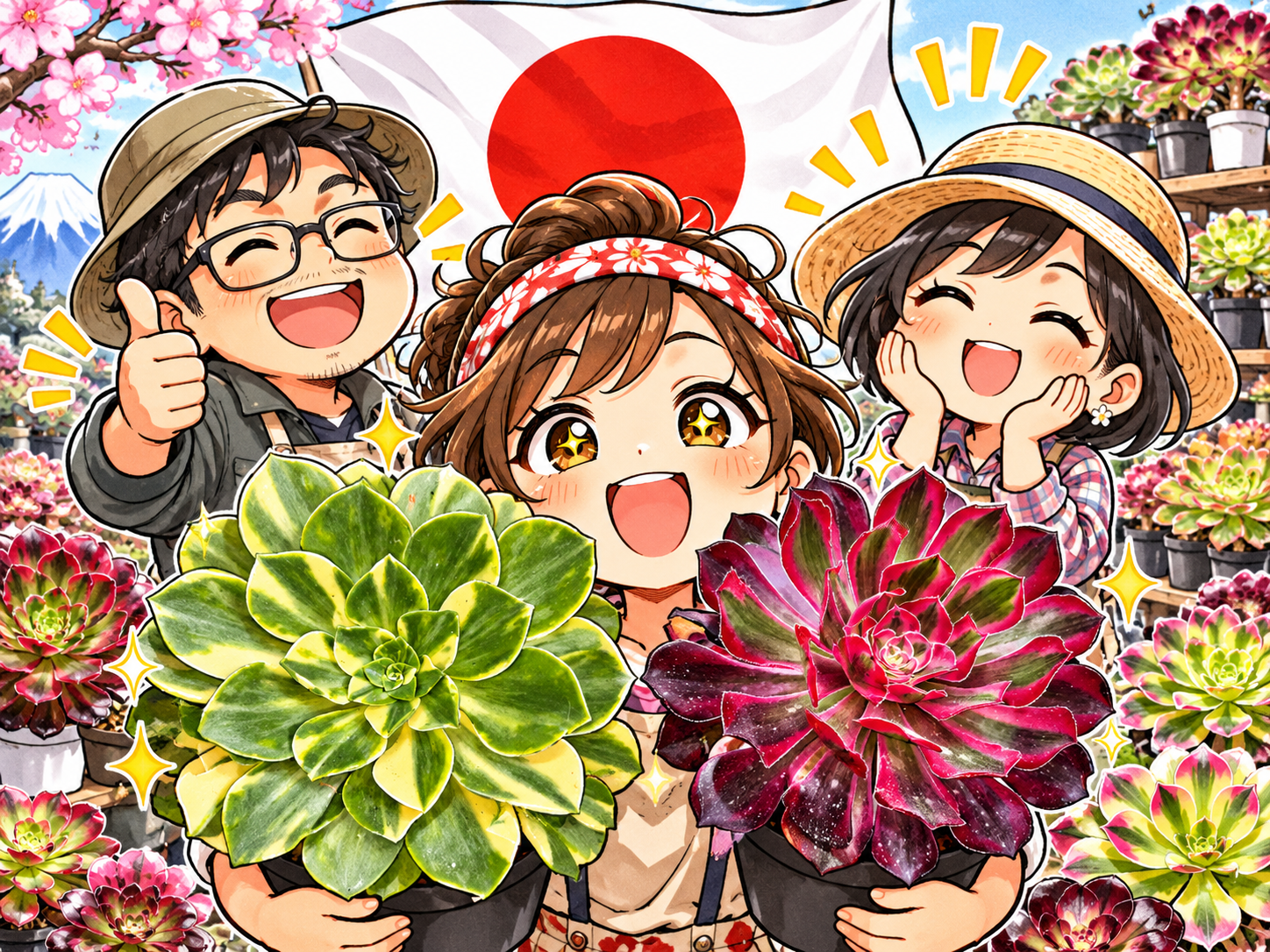
🇯🇵 Japan: a passionate community bringing Aeoniums into the spotlight
Collectors, plant breeders, specialist reference websites and social media: Japan holds a particularly interesting place in the world of Aeoniums. Here, a love of succulents goes hand in hand with sharing, close observation and the pleasure of collecting.
In Japan, Aeoniums have a history extending far beyond today’s enthusiasm for variegated varieties. From the familiar Kurohōshi (黒法師)—a Japanese name generally associated with Aeonium arboreum ‘Zwartkop’, admired for its almost black, deep-purple rosettes—to newer, brightly coloured cultivars, these plants have gradually established themselves among succulent collections.
The variety of plants available, the enthusiasm of growers and the many exchanges between collectors all point to a vibrant horticultural community.
A horticultural tradition with Japanese creations of its own
Japan does more than grow and import Aeoniums. Japanese breeders and growers have also contributed their own selections and cultivars to the history of the genus.
One of the best documented examples is Aeonium ‘Saint Simon Violet’, an outstanding variegated cultivar bred by Seiji Takahashi in Japan. A plant variety protection application was filed in 2005, followed by official registration in 2009. This shows that Japanese horticulturists were interested in variegated Aeoniums well before their more recent rise in popularity across Asia.

Other Japanese creations deserve recognition too, including Aeonium ‘Chou’ (蝶), a hybrid attributed to Naoyuki Hagane in 2019, reportedly from ‘Suncup’ and Aeonium goochiae. These plants remind us that the modern horticultural history of Aeoniums is not written in Europe or China alone: Japanese breeders have played their part.

PUKUBOOK: sharing knowledge and enthusiasm
Among Japan’s most interesting initiatives is PUKUBOOK (プクブック), an extensive online reference devoted to succulent plants. Its numerous entries, photographs and horticultural information help enthusiasts discover and understand a wide range of plants, including Aeoniums.
PUKUBOOK is a fine example of the work being done in Japan to make botanical and horticultural knowledge accessible to collectors.
Growers, specialist nurseries and retailers also contribute to this shared culture, including Ozaki Flower Park, E-TANIKU and Tropical Garden. Through plant introductions, advice, new arrivals and events, they bring Aeoniums to a diverse audience.
Instagram: an especially lively community of Japanese collectors
Social media is perhaps where this enthusiasm can best be seen. Many collectors living in Japan regularly share photographs of their plants, their seasonal transformations, cultivation experiences and sometimes truly exceptional collections.
Among them are Nhits Murakami (@aeonium.nhits), whose photographs showcase magnificent Aeoniums, and Miyako (@myaaako_aeonium), a collector in Okayama whose posts also reflect the friendships and gatherings that bring enthusiasts together.
This community is international too, as shown by Fabyzinha (@fabyzinhaz), a Brazilian living in Japan who shares her beautiful photographs of succulents and Aeoniums with a wide audience.
Many other collectors contribute to this lively exchange, including @kokianitazumi, @b.y_cats, @kobuta4740 and @mikarin7638. Their photographs let us see how cultivars grow in real collections and help enthusiasts exchange experiences across borders.
It is a generous community in which the beauty of plants becomes a shared language.
A passion connecting Japan and France
Japanese interest is also reflected in the audience of VariegatedAeonium.fr. Japan currently ranks sixth among countries visiting our website—an encouraging position for an Aeonium encyclopaedia developed in France.
It is a wonderful reminder that our passion is international and that Japanese collectors are interested in the history, origins and identities of Aeonium cultivars. Through VariegatedAeonium.fr, we hope to bring enthusiasts around the world closer together and celebrate everyone helping these remarkable plants thrive.
Our heartfelt thanks go to Japanese collectors, breeders and horticultural professionals who each help Aeoniums flourish and gain recognition.
日本のアエオニウム愛好家の皆さん、素晴らしい情熱をいつもありがとうございます!
To all Aeonium enthusiasts in Japan: thank you for your wonderful passion!
×Aichrysonium: a newly described natural hybrid genus
On 8 October 2026, Octavio Arango-Toro published the description of ×Aichrysonium montelongae in Collectanea Botanica. The taxon is presented as the first documented natural hybrid between the genera Aichryson and Aeonium. The paper also establishes the nothogenus ×Aichrysonium. Read the scientific publication.
A discovery in the herbarium, nearly thirty years later
The story begins with herbarium specimen TFC 40.631, held at the University of La Laguna since 1997. The hybrid identity of this puzzling specimen had not been recognised. The author explains how it was identified and examines morphological characters, ecology and the distribution of the parents. The same specimen serves as the holotype of the newly described nothospecies.
The proposed parents are Aichryson laxum var. laxum × Aeonium urbicum subsp. urbicum. This parentage is also cited by the Canary Islands Biodiversity Database. The order in this formula does not identify which parent supplied the seed or pollen.
What does this new name mean?
A nothogenus is a name used for a hybrid between genera; the × sign indicates that hybrid status. A nothospecies is a hybrid taxon at species rank. These terms describe a hybrid origin; they do not mean either parent genus has disappeared or changed name. There is no reason to rename the Aeoniums in our collections.
This story also highlights the value of herbaria. A plant preserved as a specimen can be studied again decades later. The year in which a name is published is not necessarily the year the plant was collected—or first appeared in nature.
Why this discovery matters
For VariegatedAeonium.fr, the discovery connects directly with a central question: how can we document relationships among Macaronesian Crassulaceae? It adds a formally described natural example to a field where many horticultural claims also circulate. It does not demonstrate that all intergeneric crosses are possible, fertile or reproducible in cultivation. Every claim of parentage requires its own evidence. For further reading, see our guide to Aeonium hybridisation.


