
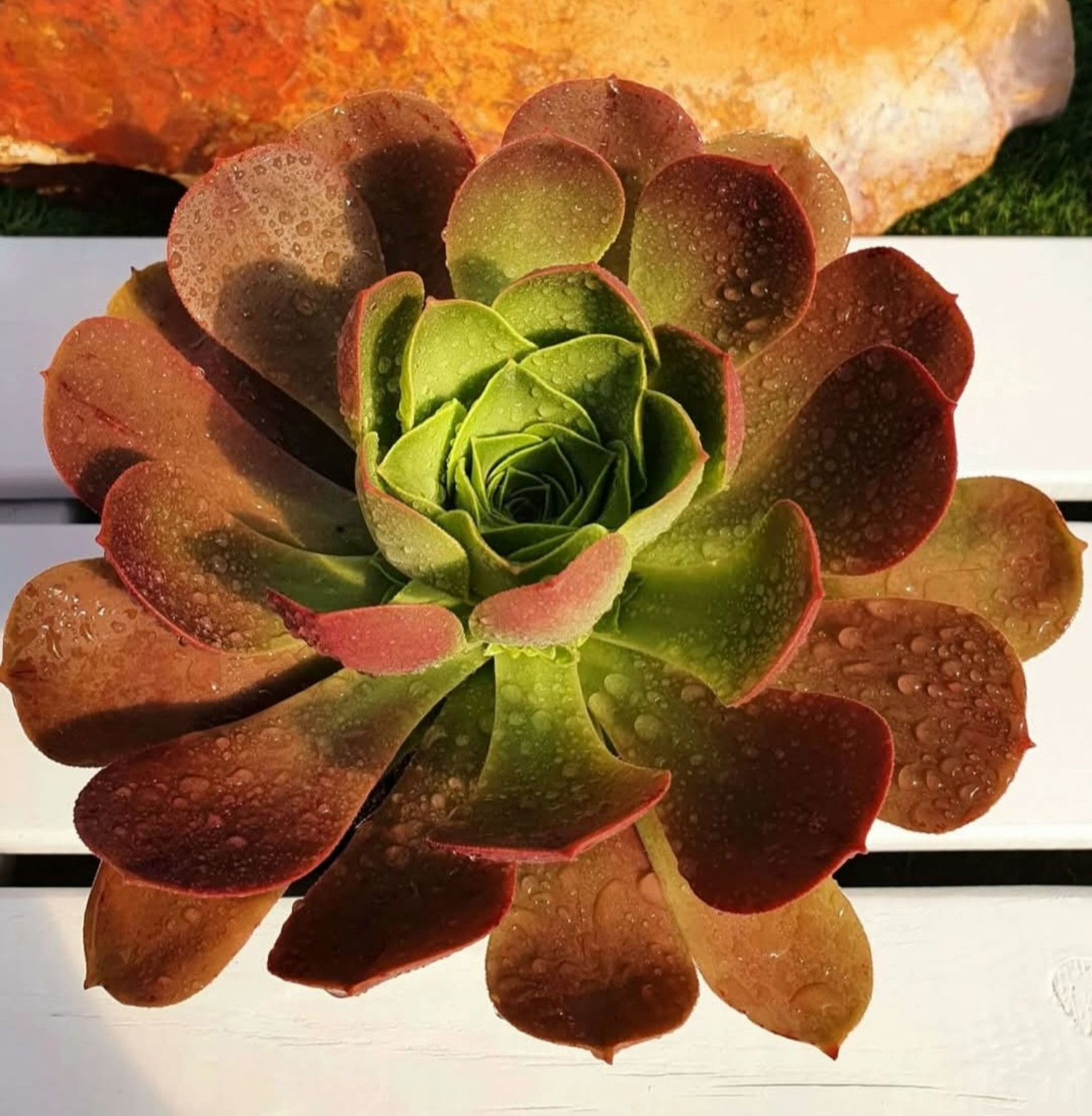
‘Californicum’ unfolds broad, open rosettes that immediately recall Aeonium canariense, of which it is a horticultural selection.
- Cultivar name
- Aeonium ‘Californicum’
- Type
- Cultivar / horticultural selection
- Horticultural origin
- California (United States)
- Genus
- Aeonium
Origin and history
Selected in California, United States, this Aeonium later entered commerce under several variations of its name, including ‘canariense v. californicum’. That wording on a plant label does not by itself establish a formally described botanical variety: the cultivar name ‘Californicum’ is the appropriate horticultural identity.
Botanical description
Aeonium ‘Californicum’ is a horticultural selection of Aeonium canariense, distinguished by large, fleshy, broad and particularly open rosettes. The leaves spread rather widely, giving the rosettes a generous outline that is less tightly packed than in some other cultivated forms of A. canariense. The plant may produce additional rosettes and gradually develop into a small clump. In cultivation, the plant may reach approximately 40 cm in height and 30 cm in spread; these are indicative measurements that depend on age and growing conditions.
The foliage consists of large, rather broad, succulent leaves, obovate to spatulate, narrowing towards the base and rounded at the tip. Their main colour ranges from light to deeper green, sometimes slightly yellow-green. The outer leaves may develop red to orange pigmentation, especially along their margins and most exposed areas, while the younger leaves in the centre remain predominantly green. This colouring changes with light and season; it is not variegation.
The most recognisable features of ‘Californicum’ are its exceptionally open rosettes, generous growth and the contrast between their green centres and the outer leaves that can turn red. Rosettes approaching 30 cm across have been reported in cultivation, but this should not be taken as a fixed measurement for the cultivar. Its horticultural identity is associated with Aeonium canariense, without evidence of a specific intentional cross; precise leaf dimensions and details of leaf pubescence are not documented well enough to quantify.
Rosette shape changes through the year. During active growth, the leaves spread widely and the rosette retains its open habit. During prolonged periods of heat and drought, the leaves move closer together and may curl inwards, while some older lower leaves shrivel or dry out. As conditions become more favourable, new growth spreads open and the rosette gradually regains its broad outline. This seasonal tightening is not a permanent feature of the plant.
Flowering
Have you photographed this cultivar in bloom? Share flowering photographs on the Forum.
Flowering is terminal and develops from a mature rosette. The flowers are described as yellow, with flowering reported from April to June by a British horticultural source; the exact timing may vary with climate and growing conditions. As in Aeonium canariense, a flowering rosette is normally monocarpic and completes its life cycle after fruiting, while any other rosettes may continue growing. Flower measurements and petal number have not been established specifically for ‘Californicum’.
Photographs
Do you grow this cultivar? Help document its shapes and seasonal colours. Share your photographs on the Forum.
Mutations of ‘Californicum’
Direct mutations

Growing conditions
☀️ Light
Bright conditions encourage balanced rosettes. Increase exposure to direct sun gradually after the plant has been kept under cover.
💧 Watering
Water while the plant is actively growing and allow the potting mix to dry adequately between applications. Cut back significantly during summer dormancy.
🪨 Potting mix
Choose an open, free-draining mix in a pot with drainage holes. Root health depends on airflow and avoiding prolonged waterlogging.
🌡️ Temperatures
Protect from frost and prolonged cold, wet conditions. Exact cold tolerance has not been established for every selection.


