
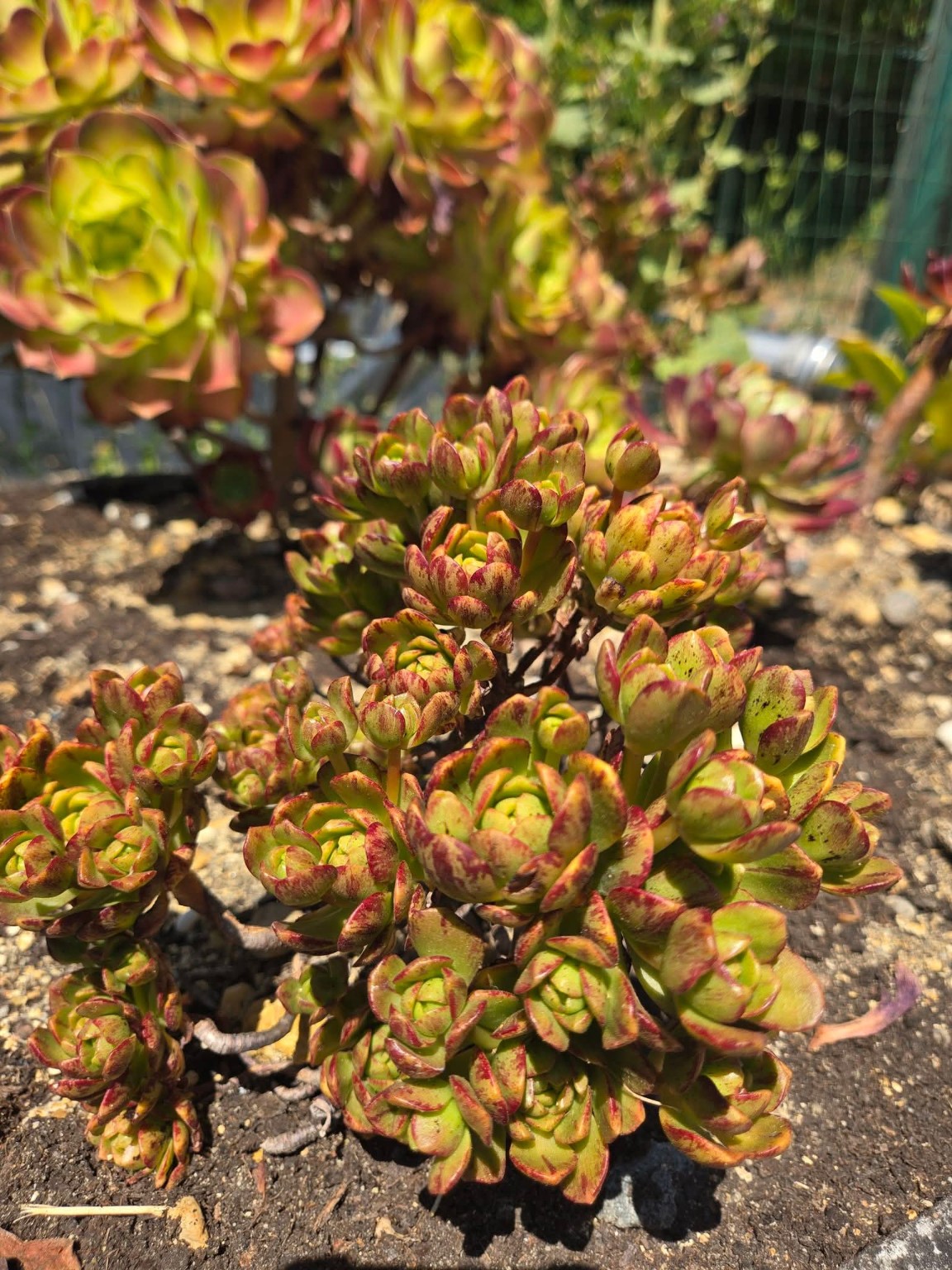
Tiny rosettes on an open, branching shrub make Aeonium × loartei a distinctive natural hybrid of Aeonium sedifolium and Aeonium spathulatum.
- Accepted name
- Aeonium × loartei
- Type
- Natural botanical hybrid
- Other names
- Aeonium × casanovense · x casanovense · x loartei
- Natural origin
- Canary Islands (Spain)
- Botanical name published
- 2007
- Botanical synonym
- Aeonium × casanovense
- Documented parentage
- Aeonium sedifolium × Aeonium spathulatum
- Habit
- Branching shrub
- Branching
- Branching
- Documented height
- 20–25 cm
- Rosette diameter
- 1.5–2 cm
- Genus
- Aeonium
- Country of origin
- Spain
- Parents
- sedifolium × spathulatum
Family tree
Reserved for Premium members
Origin and history
This natural hybrid of Aeonium sedifolium and Aeonium spathulatum was described by Giuseppe Tavormina as Aeonium × loartei in 2007 in Cactus & Co. (vol. 11, no. 3). Tavormina collected the type specimen in May 2006 in the Barranco de Masca, Teno mountains, Tenerife, at approximately 500 m elevation; it is preserved as FT 418.1. The epithet honours Félix Loarte García. In the same year, Ángel Bañares published Aeonium × casanovense based on different type material. Plants of the World Online now treats it as a heterotypic synonym of × loartei: the names reflect the taxonomic history of one natural hybrid, not two separate horticultural cultivars.
Chronological milestones
2007 — Tavormina publishes the name Aeonium × loartei in Cactus & Co.; this hybrid combines A. sedifolium and A. spathulatum.
2007 — Bañares publishes the name Aeonium × casanovense in Vieraea, now treated by Kew as a synonym of × loartei.
Botanical description
Aeonium × loartei is a natural botanical hybrid of Aeonium sedifolium and Aeonium spathulatum. In the reference description it forms a small succulent subshrub approximately 20–25 cm tall. Its spreading, branching stems give it an open, rather loose habit, less compact than that of A. sedifolium. Adventitious roots may develop along the branches. It combines features of both parent species while generally showing more robust growth.
Numerous miniature rosettes, around 1.5–2 cm across, are produced at the branch tips. In the description of A. × loartei, the obovate to spatulate leaves measure approximately 1.2 cm long and 6.5 mm wide. They are hairless, with a distinctly flat upper surface and margins lacking cilia. The green leaves may show reddish markings, particularly along their edges and midribs.
Leaf shape is one of the most useful distinguishing features from Aeonium sedifolium, a species with which the hybrid is frequently confused in cultivation. The latter has particularly thick, almost rounded leaves in cross-section, whereas those of A. × loartei are noticeably flatter above. The measurements given here describe plants documented in the botanical literature; cultivated specimens may vary.
Flowering
Have you photographed this cultivar in bloom? Share flowering photographs on the Forum.
The flowers are yellow and are usually 12-merous, occasionally 11-merous, according to the botanical description of the hybrid. The Royal Horticultural Society reports flowering in summer on mature cultivated plants; the exact season may vary with climate and growing conditions.
Photographs
Do you grow this cultivar? Help document its shapes and seasonal colours. Share your photographs on the Forum.
Summer photographs


Growing conditions
☀️ Light
Place in bright light and watch the tiny rosettes, which are exposed to rapid environmental changes.
💧 Watering
Water sparingly during active growth, letting the mix dry without keeping the fine branches sodden.
🪨 Potting mix
Use a fine-textured but free-draining mix, suitable for small rosettes and branches that may form adventitious roots.
🌡️ Temperatures
Keep frost-free and avoid stagnant moisture under cover during winter.
Help us enrich this profile
An observation, a correction or photographs? Share your knowledge with us.


