
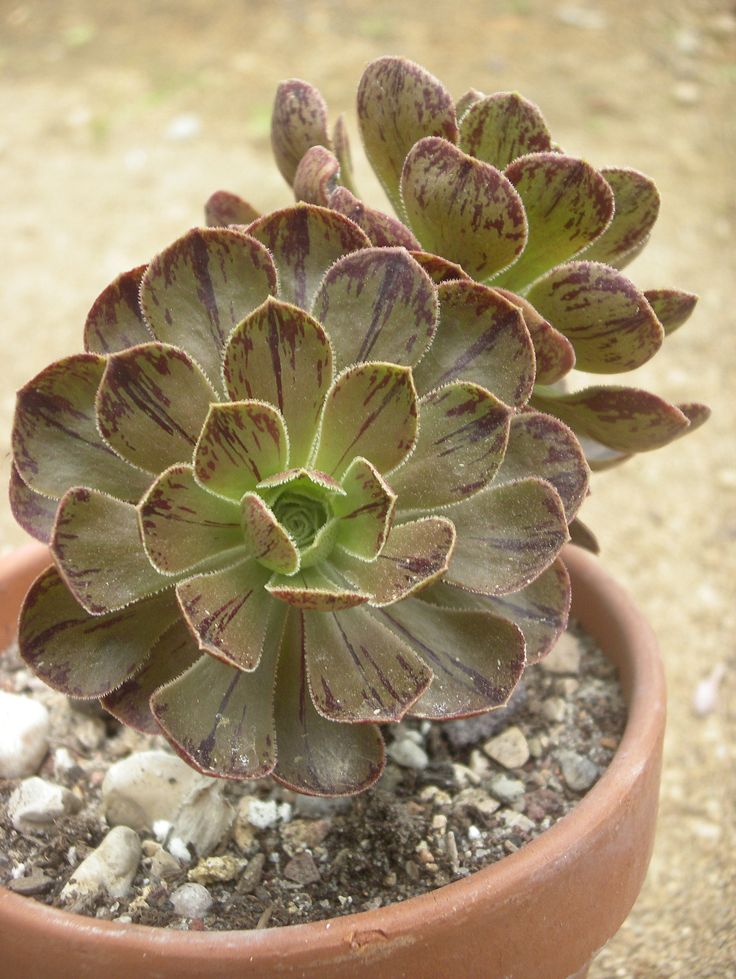
Little bouquets of rosettes, a tightly folded central bud and leaves marked with reddish brown: Aeonium × holospathulatum is a natural meeting of two Canary Island species, first documented by Ángel Bañares.
- Reference name
- x holospathulatum
- Botanical name
- Aeonium × holospathulatum Bañares
- Genus
- Aeonium
- Type
- Botanical taxon
- Country of origin
- Spain
- Growth habit
- Shrubby
- Plant height
- 30–50 cm
- Rosette diameter
- 6–9 cm
- Branching
- Branching
- Name publication
- 1986
- Parents
- arboreum subsp. holochrysum × spathulatum
Family tree
Reserved for Premium members
Origin and history
Aeonium × holospathulatum is a natural hybrid between Aeonium arboreum subsp. holochrysum and Aeonium spathulatum. In his original description published in June 1986 (Vieraea, 16, p. 66), Ángel Bañares treated holochrysum as a species; Kew currently treats it as a subspecies of arboreum.
Bañares collected the type specimen at Arafo on Tenerife in March 1981 at about 950 m elevation (TFC 19949). A 1996 paper records a further specimen collected in March 1989 near San Andrés, El Hierro, growing among its parents. This hybrid originated in nature rather than being deliberately bred in a nursery.
Bañares also distinguished nothovar. sanchezii, involving the rubrolineatum lineage and spathulatum. The present account focuses on the nominate form, without transferring characters from one hybrid to the other.
The variegated Aeonium ‘Christmas’ is commonly attributed to a sport of this hybrid, but the proposed descent has not been conclusively demonstrated. ‘Vera’ is also associated with this lineage, although its precise mother plant is not identified.
Chronological milestones
March 1981 — Type collection at Arafo, Tenerife, 950 m; holotype TFC 19949 (Ángel Bañares).
June 1986 — Aeonium × holospathulatum Bañares (1986).
March 1989 — Specimen TFC 37974 near San Andrés, El Hierro, collected by Bañares among the parent plants.
December 1996 — Publication of the extension of the nominate nothovariety’s range to El Hierro, with a March flowering record.
Botanical description
Compact rosettes and finely marked leaves
More robust than Aeonium spathulatum, the hybrid has short, almost upright branches and a thickened stem. In the original description the rosettes measure 6–9 cm across, with a prominent egg-shaped central bud surrounded by mature spreading leaves. The small spoon-shaped leaves have a tiny tip, blunt marginal cilia and conspicuous longitudinal glands on their undersides.
During active growth, the rosettes open and green leaves contrast with reddish-brown markings. In stronger light the markings may become more pronounced, with hints of copper. During summer rest the centre contracts and some outer leaves dry. These natural pigments are not variegation.
Branching gradually gives mature plants the appearance of miniature shrubs. Overall height and density depend on the growing conditions; the original description of the natural hybrid is the best identification reference.
Flowering
Have you photographed this cultivar in bloom? Share flowering photographs on the Forum.
The flowering of the nominate form deserves particular care: Bañares reported in 1986 that he had not seen it flower during five years of cultivation. His 1996 paper records flowering in March on El Hierro. Neither account specifies the colour or dimensions of flowers of the nominate form; the yellow flowers striped with red in the 1986 paper belong to × sanchezii. A correctly identified photograph would help document this section.
Photographs
Do you grow this cultivar? Help document its shapes and seasonal colours. Share your photographs on the Forum.
General photographs


Mutations of ‘x holospathulatum’
Growing conditions
☀️ Light
Provide bright light and acclimatise to direct sun gradually. Light shade is helpful during extreme heat.
💧 Watering
Water after the mix has dried during active growth, then reduce watering as rosettes contract in summer.
🪨 Substrate
Use a free-draining medium and a container with drainage holes.
🌡️ Temperatures
Protect from frost and prolonged cold wet conditions. The exact tolerance of individual plants may vary.


