
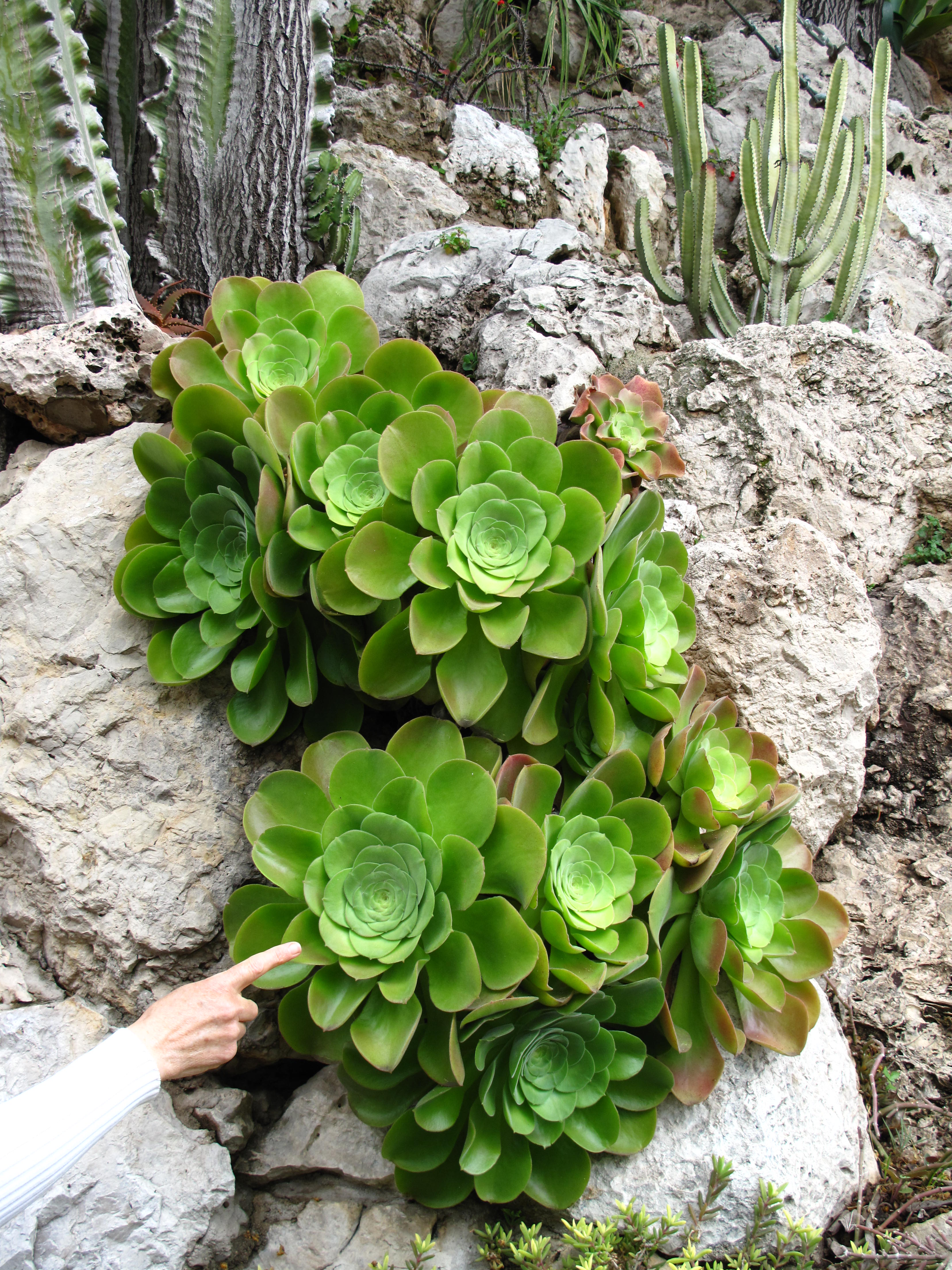
Broad soft-green leaves, a velvety texture and rosettes that open like generous cups: Aeonium canariense has a wonderfully gentle presence. It is also a beautiful example of the diversity of Aeoniums across the Canary Islands.
- Reference name
- canariense
- Botanical name
- Aeonium canariense (L.) Webb & Berthel.
- Other names
- Aeonium canariense
- Genus
- Aeonium
- Type
- Botanical taxon
- Native range
- Canary Islands
- Growth habit
- Open rosette
- Rosette diameter
- 10–60 cm
- Name publication
- 1841
Origin and history
Native to the Canary Islands, Aeonium canariense is a botanical species rather than a garden creation. Linnaeus described it in 1753 as Sempervivum canariense. Webb and Berthelot transferred it to Aeonium in 1841, the name accepted by Kew today.
Five subspecies are currently recognised by Kew: canariense on Tenerife, christii on La Palma in the more recent circumscription, latifolium on La Gomera, longithyrsum on El Hierro and virgineum on Gran Canaria. Earlier treatments sometimes included the El Hierro plants with those of La Palma.
The nominate subspecies grows on rocky slopes and cliffs in northern Tenerife, up to around 1,300 metres. Some populations occur in cooler, sheltered or partly shaded habitats; it is not a plant of extreme desert conditions.
The horticultural selection Aeonium ‘Californicum’ has been associated with this species. Growers have also linked ‘Orion’ and the related ‘Orion White’, ‘Orion Yellow’ and ‘Orion Petrify’ to this horticultural lineage. Orion’s precise origins remain uncertain; these reports do not establish a direct descent from the nominate botanical subspecies.
Chronological milestones
1753 — Sempervivum canariense L., Species Plantarum: 464 (1753).
1841 — Aeonium canariense (L.) Webb & Berthel., Histoire naturelle des îles Canaries 3(2;1): 196 (1841).
Botanical description
Large, velvety rosettes
The habit varies between subspecies. In Aeonium canariense subsp. canariense, rosettes may measure 10–60 cm across and occur singly or in clumps. The thick leaves broaden towards their rounded tips and are covered with tiny glandular hairs, giving them their distinctive velvety texture. The inner leaves often stand upright, creating a cup-shaped rosette.
During active growth the rosettes unfold in a range of luminous greens. As light and temperatures increase, the edges may develop reddish or yellowish tones. In dry weather the rosette contracts and the oldest outer leaves dry gradually. These seasonal pigments are not variegation.
Offsets sometimes appear near the base. Solitary specimens are striking for their very large rosettes, whereas clumping plants gradually form a generous bouquet. Size and branching vary with the taxon and growing conditions.
Flowering
The nominate subspecies develops a branched inflorescence 30–45 cm high, excluding its leafy stalk. Small star-shaped flowers have eight to ten whitish-green petals. The flowering rosette completes its life cycle; any remaining offsets can continue growing. The floral description is documented by the International Crassulaceae Network.


Photographs
Do you grow this cultivar? Help document its shapes and seasonal colours. Share your photographs on the Forum.
General photographs

Mutations of ‘canariense’
Documented descendants of ‘canariense’
Reserved for Premium members
Growing conditions
☀️ Light
Bright light with some shade in the hottest hours encourages broad rosettes. Acclimatise the velvety leaves gradually to direct sun.
💧 Watering
Water during active growth once the mix has dried sufficiently. Reduce watering during summer rest, without assuming extreme drought is necessary in every climate.
🪨 Substrate
Use a porous, free-draining mix and a wide, stable container for large rosettes.
🌡️ Temperatures
Protect from frost and prolonged cold wet conditions. In hot summers, choose a bright, airy position sheltered from scorching sun.


